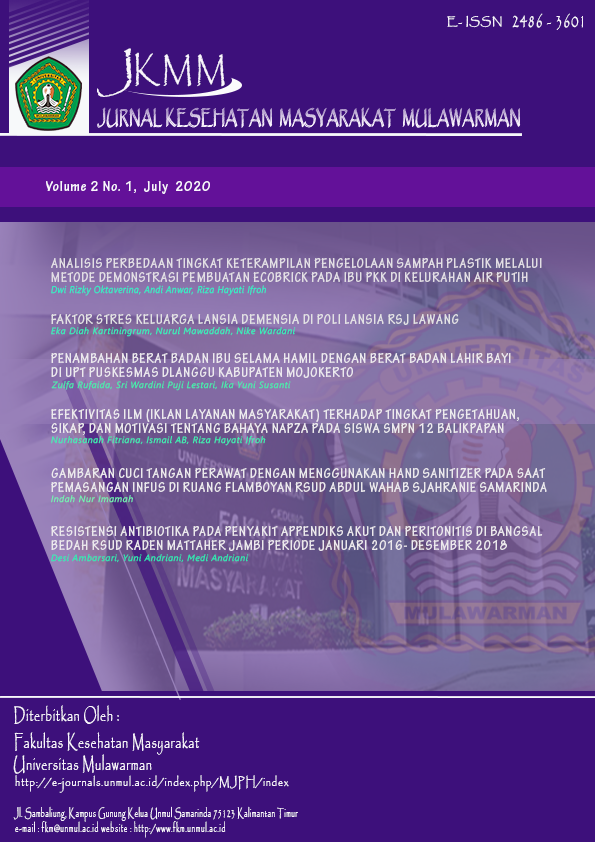
Efektivitas ILM (Iklan Layanan Masyarakat) Terhadap Tingkat Pengetahuan, Sikap, Dan Motivasi Tentang Bahaya Napza Pada Siswa SMPN 12 Balikpapan
DOI:
https://doi.org/10.30872/jkmm.v2i1.4267Abstract
Background & Objective: NDPS (Narcotics Drugs and Psychotropic Substances) are substances of drugs when it abused will cause physical, psychological, and dependency disorders. Adolescents aged (12-17 years) are at high risk for starting to use NDPS. To overcome this, it requires health education that more interesting and easy to understand by student as a form of prevention of NDPS abuse. For example, is through radio broadcast PSA (Public Service Announcement) at school. This research aim to find out the effectiveness of radio broadcast PSA to increase knowledge, attitudes and motivations regarding the dangers of NDPS abuse and its prevention for the student of SMPN 12 Balikpapan. Method: The type of this research is quantitative research method by using pre experiment with one group pre test and post test design. The study was conducted at SMPN 12 Balikpapan with 40 students as a samples. The data were processed and analyzed using Paired T-test and Wilcoxon test. Results: The results of data analysis showed that there is a differences level of knowledge, attitudes, and motivation before and after intervention of PSA broadcasts (p-value < 0,05). Conclusion: PSA is effective to increase student's knowledge,attitudes, and motivation to preventing the use of NDPS.References
Ahmad, R. (2010). Aplikasi Metodologi Penelitian Kesehatan. Yogyakarta.
Alifia, U. (2007). Apa itu Narkotika dan Napza. Semarang: PT. Balai Pustaka (Persero).
Arief S. Sadiman dkk. (2012). Media Pendidikan: Pengertian, Pengembangan, dan Pemanfaatannya. Jakarta: PT. Raja Grafindo Persada.
Arikunto, S. (2010). Prosedur Penelitian Suatu Pendekatan Praktik. Jakarta: Rineka Cipta.
Azwar, S. (2000). Sikap Manusia, Teori dan Pengukurannya. Yogyakarta: Pustaka Pelajar Jogja Offset.
B. Uno, H. (2007). Teori Motivasi dan Pengukurannya. Jakarta: Bumi Aksara.
BNN. (2014). Buletin NAPZA 2014. Jakarta: Badan Narkotika Nasional Republik Indonesia.
BNN. (2017). Hasil Survey Penyalahgunaan dan Peredaran Gelap Narkoba Pada Kelompok Pelajar dan
Mahasiswa Di 18 Provinsi Tahun 2016. Ringkasan Eksekutif Hasil Survei BNN Tahun 2017, 108.
Retrievedfromhttp://www.bnn.go.id/_multimedia/document/20170227/ringkasan_eksekutif_rev_
cetak_18_feb.pdf
BNN. (2018). Puslitdatin Tahun 2018 (Indonesia : Narkoba Dalam Angka Tahun 2017). Jakarta: Badan
Narkotika Nasional Republik Indonesia.
BNNK. (2017). Angka Kasus Narkoba Kota Balikpapan. Balikpapan.
Fanda, R. B., Marni, & Limbu, R. (2011). Komparasi Efektivitas Penggunaan Radiospot dan Power Point terhada Peningkatan Pengetahuan Remaja Tentang Kesehatan Gigi (Studi Pada Pusat Pengembangan Anak Pancaran Kasih Event Organizer 721 di Namosain Kupang Tahun 2011). Thesis. PKIP FKM Undana.
Fauza, R., & Mubarokah, K. (2016). Efektivitas Radio Spot Terhadap Peningkatan Pengetahuan Tentang
Perawatan Kesehatan Organ Reproduksi Pada Siswa SMP 2 Subah Kabupaten Batang Jawa
Tengah. Jurnal Kesehatan Masyarakat, 17. Retrieved from
https://publikasi.dinus.ac.id/index.php/visikes/article/download/2121/135
Gertrude, G. (2015). Programmes , The Use and Impact of Vernacular Radio in Malaria Control in Emuhaya District, Kenya. Journal of Communication, 50. Retrievedfrom
https://journalism.uonbi.ac.ke/sites/default/files/chss/journalism/Vernacular Radio and Health
Promotion.pdf
Hanif, M. (2017). Pengaruh Pendidikan Kesehatan Melalui Audio Visual Narkoba Pada Remaja Kelas
VIII di SMP Ma’arif Gamping Yogyakarta. Universitas ’Aisyiyah Yogyakarta.
Harlina, L. (2012). Pencegahan dan Penanggulangan Penyalahgunaan Narkoba Berbasis Sekolah.
Jakarta: Balai Pustaka.
Hawari, D. (2016). Penyalahgunaan dan Ketergantungan NAPZA. Fakultas Kedokteran Universitas
Indonesia.
Irwanto. (2007). Psikologi Umum. Jakarta: Gramedia Pustaka Utama.
Jehani, Libertus, dan A. (2006). Mencegah Terjerumus Narkoba. Tanggerang: Visimedia.
Kabain, A. (2011). Bahaya Penyalahgunaan Narkoba. Semarang: Bengawan Ilmu.
Kardes, & Frank, R. (2001). Consumer Behaviour. New York: Mac Millan Publishing Company.
Kasali, R. (2007). Manajemen Periklanan, Konsep, dan Aplikasinya di Indonesia (Cetakan Ke). Jakarta:
Pustaka Utama Grafiti.
Kemenkes RI. (2010). Penyalahgunaan NAPZA. Kementerian Kesehatan RI. Jakarta: Kemenkes RI.
Kemenkes RI. (2017). Buku Informasi Kesehatan Peserta Didik Tingkat SMP/MTs dan SMA/SMA/MA.
Jakarta: Kemenkes RI.
Kementerian Kesehatan Republik Indonesia. (2015). Infodatin Reproduksi Remaja Tahun 2015. Jakarta.
Kirana, D. Z. (2014). Keefektifan Penggunaan Media Lagu Pada Pembelajaran Keterampilan Berbicara
Bahasa Jerman Peserta Didik Kelas X di Madrasah Aliyah Negeri Purworejo. Universitas Negeri Yogyakarta. Retrieved from http://eprints.uny.ac.id/18892/1/Dita Zahra Kirana 110203241011.pdf
Lemeshow ., Hosmer, D. W., Klar, J., dan Lwanga, S. K. (1997). Besar Sampel Dalam Penelitian Kesehatan. (N. Susanto, Ed.) (Terjemahan). Yogyakarta: Gajah Mada University Press.
Lumbantobing. (2007). Serba-Serbi Narkotika. Jakarta: Fakultas Kedokteran Universitas Indonesia.
M. Romli, A. S. (2009). Dasar-dasar Siaran Radio. Bandung: Nuansa.
Maharti, V. I. (2015). Faktor-faktor yang Berhubungan dengan Perilaku Penyalahgunaan Narkoba pada
Remaja Usia 15-19 Tahun Di Kecamatan Semarang Utara Kota Semarang. Kesehatan Masyarakat Universitas Diponegoro, 3.
Maulana, D. H. (2009). Promosi Kesehatan. Jakarta: EGC.
Mowen, J. C., & Minor, M. (2002). Perilaku Konsumen (Jilid 1) (Edisi Keli). Jakarta: Erlangga.
Ningsih, D. U. (2015). Pengaruh Penyuluhan Kesehatan Terhadap Motivasi Dalam Upaya Pencegahan
Kanker Serviks Pada Siswi Kelas X Di SMA Negeri 1 Sanden Bantul Yogyakarta. Sekolah Tinggi Ilmu Kesehatan ’Aisyiah Yogyakarta.
Notoatmodjo, S. (2007). Promosi Kesehatan dan Ilmu Perilaku. Jakarta: Rineka Cipta.
Notoatmodjo, S. (2010). Metodologi Penelitian Kesehatan. Jakarta: Rineka Cipta.
Notoatmodjo, S. (2012). Promosi Kesehatan dan Perilaku Kesehatan. Jakarta: Rineka Cipta. Jakarta: Rineka Cipta. https://doi.org/10.1017/CBO9781107415324.004
Pesonawati, J. (2014). Pengaruh Penyuluhan Kesehatan Terhadap Sikap Remaja Tentang Bahaya
Penyalahgunaan Narkona di SMA Negeri 2 Sukoharjo. Fakultas Kedokteran. Universitas
Muhammadiyah Surakarta.
Potter, P. A., & Perry, A. (2005). Buku Ajar Fundamental Keperawatan: Konsep, Proses, dan Praktik
(4th. ed). (A. B. Y. A. (et Al.), M. Ester, & Devi Yulianti (Eds.), Eds.) (4th ed.). Jakarta: Buku Kedokteran EGC.
Puwanto, N. (2014). Psikologi Pendidikan. Bandung: PT Remaja Rosdakarya Offset.
Ruslan, R. (2006). Manajemen Humas dan Manajemen Komunikasi (Konsepsi dan Aplikasi). Jakarta:
PT. Raja Grafindo Persada.
Saloso, I. (2011). Pengaruh Media Audio (Lagu Anak-Anak) dan Media Visual (Kartu Bergambar) Terhadap Pengetahuan Gizi (PUGS dan PHBS) Serta Tingkat Penerimaannya Pada Anak Usia Sekolah Dasar Negeri di Kota Bogor. Departemen Gizi Masyarakat. Institut Pertanian Bogor.
Sanjaya, W. (2008). Strategi Pembelajaran Berorientasi Standar Proses Pendidikan. Jakarta: Kencana.
Sarwono. (2011). Psikologi Remaja. Jakarta: Rajawali Press.
Sastroasmoro, S., & Ismael, S. (2011). Dasar-dasar Metodologi Penelitian Klinis. Jakarta: Bani Rupa Aksara.
Setiyawati, dkk. (2015). Buku Seri Bahaya Narkoba Jilid I. Jakarta: PT. Raja Grafindo Persada.
Sukini. (2015). Pengaruh Pendidikan Kesehatan Tentang NAPZA Terhadap Pengetahuan dan Sikap Siswa Kelas III SMK Muhammadiyah Kartasura. Kesehatan Masyarakat.
Susanti, L. (2008). Komunikasi Masalah Kesehatan (Studi Pada Radio Kotaperak Yogyakarta).
Universitas Islam Negeri Sunan Kalijaga Yogyakarta.
Tri Andini, N. (2009). How To Create Good Radio Commercials. Jakarta: Universitas Gunadarma. Retrieved from http://widya.staff.gunadarma.ac.id/Downloads/files/41816/e-book-iklan-radio.pdf
Triwibowo, C., & Puspahandani, M. E. (2015). Pengantar Dasar Ilmu Kesehatan Masyarakat Untuk Mahasiswa Kesehatan Masyarakat, Keperawatan, dan Kebidanan. Yogyakarta: Nuha Medika.
Tuntas Bagyono. (2013). Kunci Praktis Untuk Metodologi Penelitian Kesehatan Promotif-Preventif.
Yogyakarta: Penerbit Ombak.
UNODC. (2017). Methodology – World Drug Report 2017. United Nations Office on Drugs and Crime.
Wawan, A., & Dewi, M. (2010). Teori dan Pengukuran Pengetahuan, Sikap, dan Perilaku Manusia. Yogyakarta: Nuha Medika.
Widayatun, T. (2009). Ilmu Perilaku. Jakarta: Agung Seto.
Wilis, S. S. (2017). Remaja dan Masalahnya. Bandung: Alfabeta.
Yusuf, S. (2002). Psikologi Perkembangan Anak dan Remaja. Bandung: Remaja Rosdakarya.
Downloads
Published
Issue
Section
License
The copyright of this article is transferred to Jurnal Kesehatan Masyarakat Mulawarman (JKMM) and when the article is accepted for publication. The authors transfer all and all rights into and to paper including but not limited to all copyrights in the Jurnal Kesehatan Masyarakat Mulawarman. The author represents and warrants that the original is the original and that he/she is the author of this paper unless the material is clearly identified as the original source, with notification of the permission of the copyright owner if necessary. The author states that he has the authority and authority to make and carry out this task.
The author states that:
- This paper has not been published in the same form elsewhere.
- This will not be submitted elsewhere for publication prior to acceptance/rejection by this journal.
A Copyright permission is obtained for material published elsewhere and who require permission for this reproduction. Furthermore, I / We hereby transfer the unlimited publication rights of the above paper to Jurnal Kesehatan Masyarakat Mulawarman. Copyright transfer includes exclusive rights to reproduce and distribute articles, including reprints, translations, photographic reproductions, microforms, electronic forms (offline, online), or other similar reproductions.
The author's mark is appropriate for and accepts responsibility for releasing this material on behalf of any and all coauthor. This Agreement shall be signed by at least one author who has obtained the consent of the co-author (s) if applicable. After the submission of this agreement is signed by the author concerned, the amendment of the author or in the order of the author listed shall not be accepted.
Rights / Terms and Conditions Saved
- The author keeps all proprietary rights in every process, procedure, or article creation described in Work.
- The author may reproduce or permit others to reproduce the work or derivative works for the author's personal use or for the use of the company, provided that the source and the Jurnal Kesehatan Masyarakat Mulawarman copyright notice are indicated, the copy is not used in any way implying the Jurnal Kesehatan Masyarakat Mulawarman (JKMM) approval of the product or service from any company, and the copy itself is not offered for sale.
- Although authors are permitted to reuse all or part of the Works in other works, this does not include granting third-party requests to reprint, republish, or other types of reuse.
Article Processing Charge
In order to improve the quality of articles, starting in June 2025 each article to be published in JKMM is subjected to a fee of IDR 550,000 or USD 34.
These fee include the costs of reviewing, translating, proofreading, layout, and publishing articles. Price does not include printed books and postage. The fee will be paid before entering the review process by reviewer.
More information about the Article Processing Charge, please Contact the journal representative through our number in footage information below.