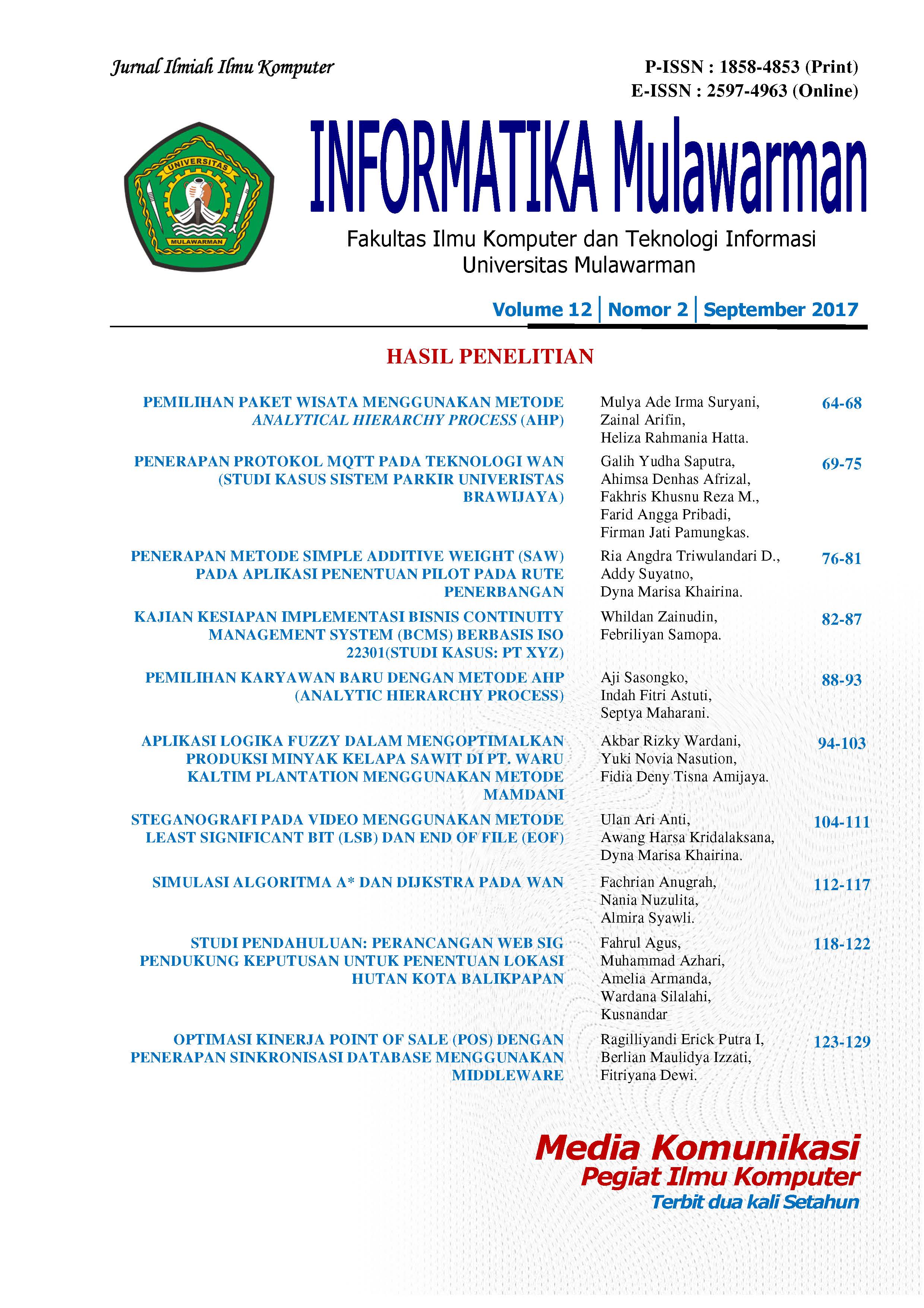
Steganografi Pada Video Menggunakan Metode Least Significant Bit (LSB) Dan End Of File (EOF)
DOI:
https://doi.org/10.30872/jim.v12i2.658Keywords:
Steganografi, Video, Embedding, Extraction, EOF, LSB.Abstract
Steganografi adalah teknik dan seni untuk menyembunyikan pesan atau informasi dalam suatu media, seperti teks, gambar, audio ataupun video yang bertujuan untuk menghindari kecurigaan dari orang yang tidak berhak. Untuk itu diperlukan sebuah perangkat lunak yang dapat menyembunyikan informasi yang bersifat rahasia pada sebuah media yaitu video. Penyembunyian data pada file video dikenal dengan istilah steganografi video. Metode steganografi yang dikenal diantaranya metode Least Significant Bit (LSB) dan Metode End Of File (EOF). Tujuan penelitian yakni untuk mengimplementasikan metode LSB dan EOF untuk menyisipkan pesan teks ke dalam file video. Hal ini diperlukan karena sering terjadi bahwa pesan teks yang dikirim merupakan suatu pesan rahasia yang tidak boleh diketahui sembarang orang. Dua metode yang dapat digunakan adalah Metode LSB dan metode EOF. Metode LSB bekerja dengan mengganti bit terakhir kode biner citra dengan kode biner pesan, sedangkan metode EOF bekerja dengan menambahkan nilai desimal pesan ke dalam pixel citra terakhir. Kelebihan metode LSB adalah ukuran dimensi video yang mengandung pesan tidak berubah, sedangkan kekurangannya adalah kapasitas pesan yang akan disisipkan terbatas sesuai dengan jumlah frame. Sebaliknya metode EOF mempunyai kelebihan dapat menyisipkan pesan dalam jumlah yang tidak terbatas, sedangkan kekurangannya adalah dimensi video akan bertambahReferences
Maula, Ismiatul. 2016. Steganografi Teks Pada Video Menggunakan Metode End Of File (EOF). Skripsi. Universitas Mulawarman.
Hendrawati. 2013. Keamanan Data Dengan Menggunakan Algoritma Rivest Code 4 (RC4) dan Steganografi Pada Citra Digital. Skripsi. Univeristas Mulawarman.
Agrawal, V.K. 2007. Perceptual Watermarking of Digital Video using The Variable Temporal Length 3D-DCT. Thesis. Department of Electrical Engineering, Indian Institute of Technology, Kanpur
Ariyus, D. 2009. Keamanan Multimedia. Yogyakarta: Andi.
Vembrina, Y. (2006). Spread Spectrum Steganograpy. Bandung: Sekolah Teknik Elektro dan Informatika.
Rahim, M. 2006. Teknik Penyembunyian Data Rahasia Dengan Menggunakan Citra Digital Sebagai Berkas Penampung. Semarang : Universitas Diponegoro.
Agutaviana, ilmia. 2012. Aplikasi Pesan Rahasia Berbasis Web Menggunakan Vigenere Chiper Dan Steganografi End Of File . Skripsi. Universitas mulawarman
Edisuryana, M., Isnanto, R.R., Somantri, M.. 2013. Aplikasi Steganografi Pada Citra Berformat Bitmap Dengan Menggunakan Metode End Of File. Jurnal Teknik Elektro. Universitas Diponegoro Semarang.
Sukrisno, U. E. (2007). Implementasi Steganografi Teknik EOF Dengan Gabungan Enkripsi Rijndael, Shift Cipher dan Fungsi Hash MD5. In Seminar Nasional Teknologi (SNT).
Ida Ayu Laksmi Dewi. 2015. Frame Rate Minimum Pada Video Tanpa Kompresi Menggunakan Normalized Frame Difference Sebagai Pendeskripsi Intensitas Gerak. Skripsi. Jurusan Teknik Elektro Fakultas Teknik Universitas Udayana.
Downloads
Published
Issue
Section
License
Copyright Transfer StatementThe copyright of this article is transferred to Informatika Mulawarman : Jurnal Ilmiah Ilmu Komputer and when the article is accepted for publication. the authors transfer all and all rights into and to paper including but not limited to all copyrights in the Informatika Mulawarman. The author represents and warrants that the original is the original and that he/she is the author of this paper unless the material is clearly identified as the original source, with notification of the permission of the copyright owner if necessary. The author states that he has the authority and authority to make and carry out this task.
The author states that:
- This paper has not been published in the same form elsewhere.
- This will not be submitted elsewhere for publication prior to acceptance/rejection by this Journal.
A Copyright permission is obtained for material published elsewhere and who require permission for this reproduction. Furthermore, I / We hereby transfer the unlimited publication rights of the above paper to Informatika Mulawarman : Jurnal Ilmiah Ilmu Komputer. Copyright transfer includes exclusive rights to reproduce and distribute articles, including reprints, translations, photographic reproductions, microforms, electronic forms (offline, online), or other similar reproductions.
The author's mark is appropriate for and accepts responsibility for releasing this material on behalf of any and all coauthor. This Agreement shall be signed by at least one author who has obtained the consent of the co-author (s) if applicable. After the submission of this agreement is signed by the author concerned, the amendment of the author or in the order of the author listed shall not be accepted.
Rights / Terms and Conditions Saved
- The author keeps all proprietary rights in every process, procedure, or article creation described in Work.
- The author may reproduce or permit others to reproduce the work or derivative works for the author's personal use or for the use of the company, provided that the source and the Informatika Mulawarman copyright notice are indicated, the copy is not used in any way implying the Journal of Informatika Mulawarman (JIM) approval of the product or service from any company, and the copy itself is not offered for sale.
- Although authors are permitted to reuse all or part of the Works in other works, this does not include granting third-party requests to reprint, republish, or other types of reuse.

Informatika Mulawarman by http://e-journals.unmul.ac.id/index.php/JIM/index is licensed under a Creative Commons Attribution-ShareAlike 4.0 International License.
under the CC BY-SA license, authors and other users are able to reprint, distribute or use the material for commercial purposes so long as they give attribution to the journal Informatika Mulawarman and license the republished material under the same license.