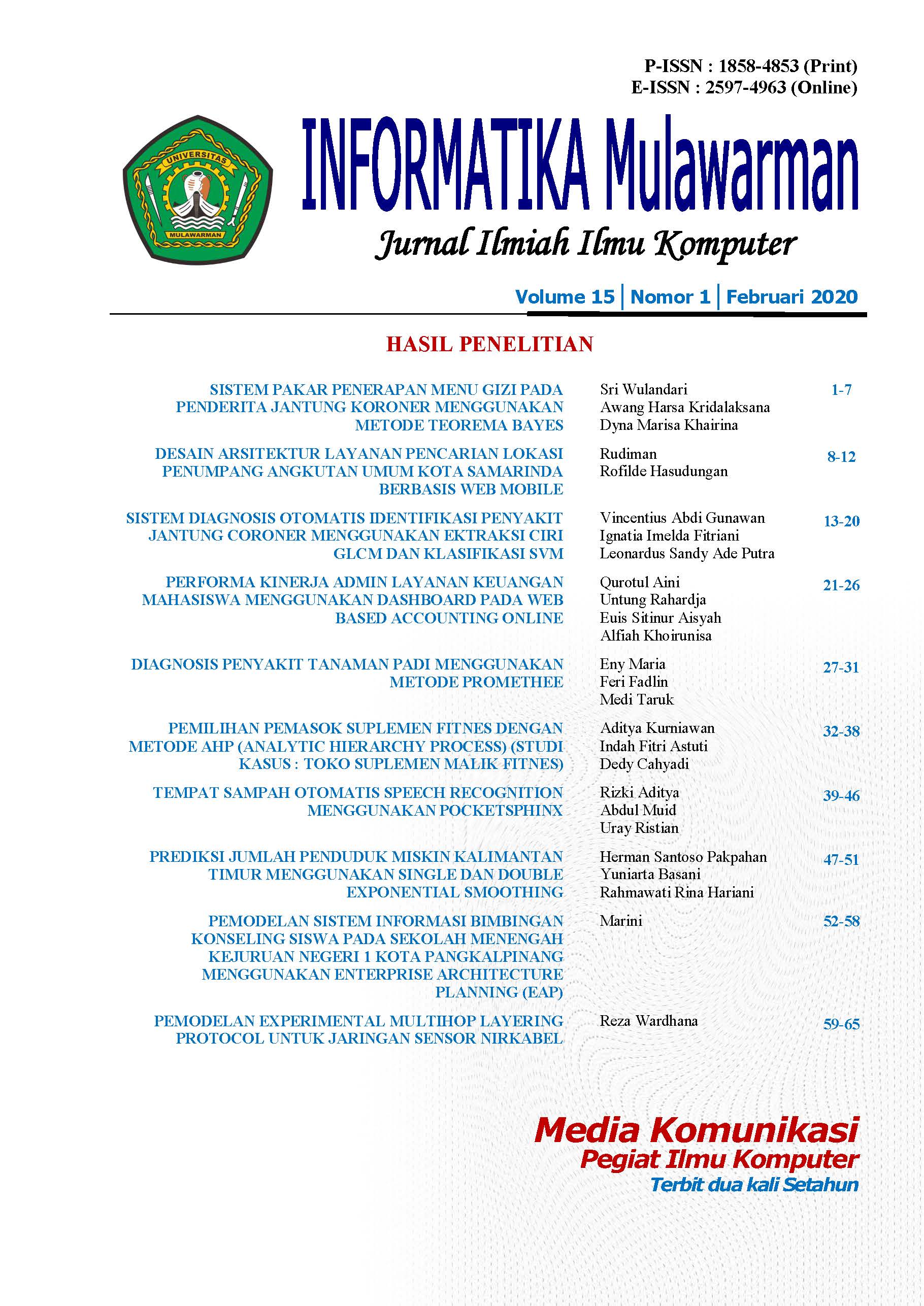
Pemodelan Multi-Layer Multihop Routing Protocol Pada Jaringan Wireless Sensor Network
DOI:
https://doi.org/10.30872/jim.v15i1.3315Keywords:
routing protocol, wireless sensor network, multihop, multi layer, kuat signal,Abstract
Beberapa tahun terakhir penelitian tentang pembagian tingkatan berdasarkan jarak untuk menghemat penggunakaan energi dalam transmisi data routing protocol banyak dilakukan. Dalam beberapa penelitian pembagian berdasarkan jarak ini terbukti menghemat energi cukup efisien. Dalam penelitian ini, peneliti mencoba membagi node berdasarkan jarak antara node ke basestation dan mengklasifikasikan nya kedalam tingkatan yang disebut oleh peneliti sebagai Multi-Layer. Selain itu peneliti menggunakan metode multihop sebagai metode routing yang di pilih untuk diterapkan dalam jaringan sensor nirkabel. Dalam simulasi yang peneliti lakukan menggunkan software Matlab, peneliti mampu menghemat penggunaan energi leader node sebesar 12,2% dibanding penelitian sebelumnya, dan energi total jaringan sebesar 2,9%.
References
Ergen, S. C., & Varaiya, P. (2010). TDMA scheduling algorithms for wireless sensor networks. Wireless Networks, 16(4), 985–997. https://doi.org/10.1007/s11276-009-0183-0
Heinzelman, W. R., Chandrakasan, A., & Balakrishnan, H. (2000). Energy-efficient communication protocol for wireless microsensor networks. Proceedings of the 33rd Annual Hawaii International Conference on System Sciences, 00(c), 1–10. https://doi.org/10.1109/HICSS.2000.926982
Karl, H., & Willig, A. (2006). Protocols and Architectures for Wireless Sensor Networks. In Jhon Wiley and Sons. https://doi.org/10.1002/0470095121
Kerasiotis, F., Prayati, A., Antonopoulos, C., Koulamas, C., & Papadopoulos, G. (2010). Battery lifetime prediction model for a WSN platform. Proceedings - 4th International Conference on Sensor Technologies and Applications, SENSORCOMM 2010, 525–530. https://doi.org/10.1109/SENSORCOMM.2010.85
Kulshrestha, J., & Mishra, M. K. (2018). DPEGASIS: Distributed PEGASIS for chain construction by the nodes in the network or in a zone without having global network topology information. IMPACT 2017 - International Conference on Multimedia, Signal Processing and Communication Technologies, 13–17. https://doi.org/10.1109/MSPCT.2017.8363964
Kumar, V. K., & Khunteta, A. (2018). Energy efficient PEGASIS routing protocol for wireless sensor networks. Proceedings - 2nd International Conference on Micro-Electronics and Telecommunication Engineering, ICMETE 2018, 91–95. https://doi.org/10.1109/ICMETE.2018.00031
Lindsey, S., & Raghavendra, C. (2002). PEGASIS: Power efficient Gathering in sensor information systems. Proceeding of IEEE Aerospace Conference, 3, 1125–1130. https://doi.org/10.1109/AERO.2002.1035242
Mishra, A. K., Rahman, R. U., Bharadwaj, R., & Sharma, R. (2016). An enhancement of PEGASIS protocol with improved network lifetime for Wireless Sensor Networks. 2015 IEEE Power, Communication and Information Technology Conference, PCITC 2015 - Proceedings, 142–147. https://doi.org/10.1109/PCITC.2015.7438149
Rappaport, T. S. (1996). Wireless Communication Principles & Practice (1st Editio). New Jersey: Pearson.
Sasaki, M., Furuta, T., Ukai, T., & Ishizaki, F. (2016). TDMA scheduling problem avoiding interference in multi-hop wireless sensor networks. Journal of Advanced Mechanical Design, Systems and Manufacturing, 10(3), 1–8. https://doi.org/10.1299/jamdsm.2016jamdsm0047
Singh, S. K., Singh, M. P., & Singh, D. K. (2010). Routing protocols in wireless sensor networks -A Survey. International Journal of Computer Science & Engineering Survey (IJCSES), 1(2), 63–83. https://doi.org/10.3390/s91108399
Sreeja, B. ., Jayakumar, L., & Saratha Devi, G. (2018). Wireless sensor network applications : A study. International Journal of Pure and Applied Mathematics, 118(11), 385–390. https://doi.org/10.12732/ijpam.v118i11.47
Wardhana, R., Nugroho, L. E., & Widyawan, W. (2017). Pemodelan Multi Level Hierarchical Protocol Berdasarkan Kuat Signal Dan Topology Control Untuk Jaringan Sensor Nirkabel (Universitas Gadjah Mada). Retrieved from http://lib.ugm.ac.id/ind/?page_id=248
William, I. O., & D. Cowan, S. (1971). The Truth About CB Antennas (First Edit). Radio Publication, Wilton.
Zheng, J., & Jamalipour, A. (2008). Wireless Sensor Networks: A Networking Perspective. In J. Zheng & A. Jamalipour (Eds.), A John Wiley & Sons, INC. https://doi.org/10.1002/9780470443521
Downloads
Published
Issue
Section
License
Copyright Transfer StatementThe copyright of this article is transferred to Informatika Mulawarman : Jurnal Ilmiah Ilmu Komputer and when the article is accepted for publication. the authors transfer all and all rights into and to paper including but not limited to all copyrights in the Informatika Mulawarman. The author represents and warrants that the original is the original and that he/she is the author of this paper unless the material is clearly identified as the original source, with notification of the permission of the copyright owner if necessary. The author states that he has the authority and authority to make and carry out this task.
The author states that:
- This paper has not been published in the same form elsewhere.
- This will not be submitted elsewhere for publication prior to acceptance/rejection by this Journal.
A Copyright permission is obtained for material published elsewhere and who require permission for this reproduction. Furthermore, I / We hereby transfer the unlimited publication rights of the above paper to Informatika Mulawarman : Jurnal Ilmiah Ilmu Komputer. Copyright transfer includes exclusive rights to reproduce and distribute articles, including reprints, translations, photographic reproductions, microforms, electronic forms (offline, online), or other similar reproductions.
The author's mark is appropriate for and accepts responsibility for releasing this material on behalf of any and all coauthor. This Agreement shall be signed by at least one author who has obtained the consent of the co-author (s) if applicable. After the submission of this agreement is signed by the author concerned, the amendment of the author or in the order of the author listed shall not be accepted.
Rights / Terms and Conditions Saved
- The author keeps all proprietary rights in every process, procedure, or article creation described in Work.
- The author may reproduce or permit others to reproduce the work or derivative works for the author's personal use or for the use of the company, provided that the source and the Informatika Mulawarman copyright notice are indicated, the copy is not used in any way implying the Journal of Informatika Mulawarman (JIM) approval of the product or service from any company, and the copy itself is not offered for sale.
- Although authors are permitted to reuse all or part of the Works in other works, this does not include granting third-party requests to reprint, republish, or other types of reuse.

Informatika Mulawarman by http://e-journals.unmul.ac.id/index.php/JIM/index is licensed under a Creative Commons Attribution-ShareAlike 4.0 International License.
under the CC BY-SA license, authors and other users are able to reprint, distribute or use the material for commercial purposes so long as they give attribution to the journal Informatika Mulawarman and license the republished material under the same license.