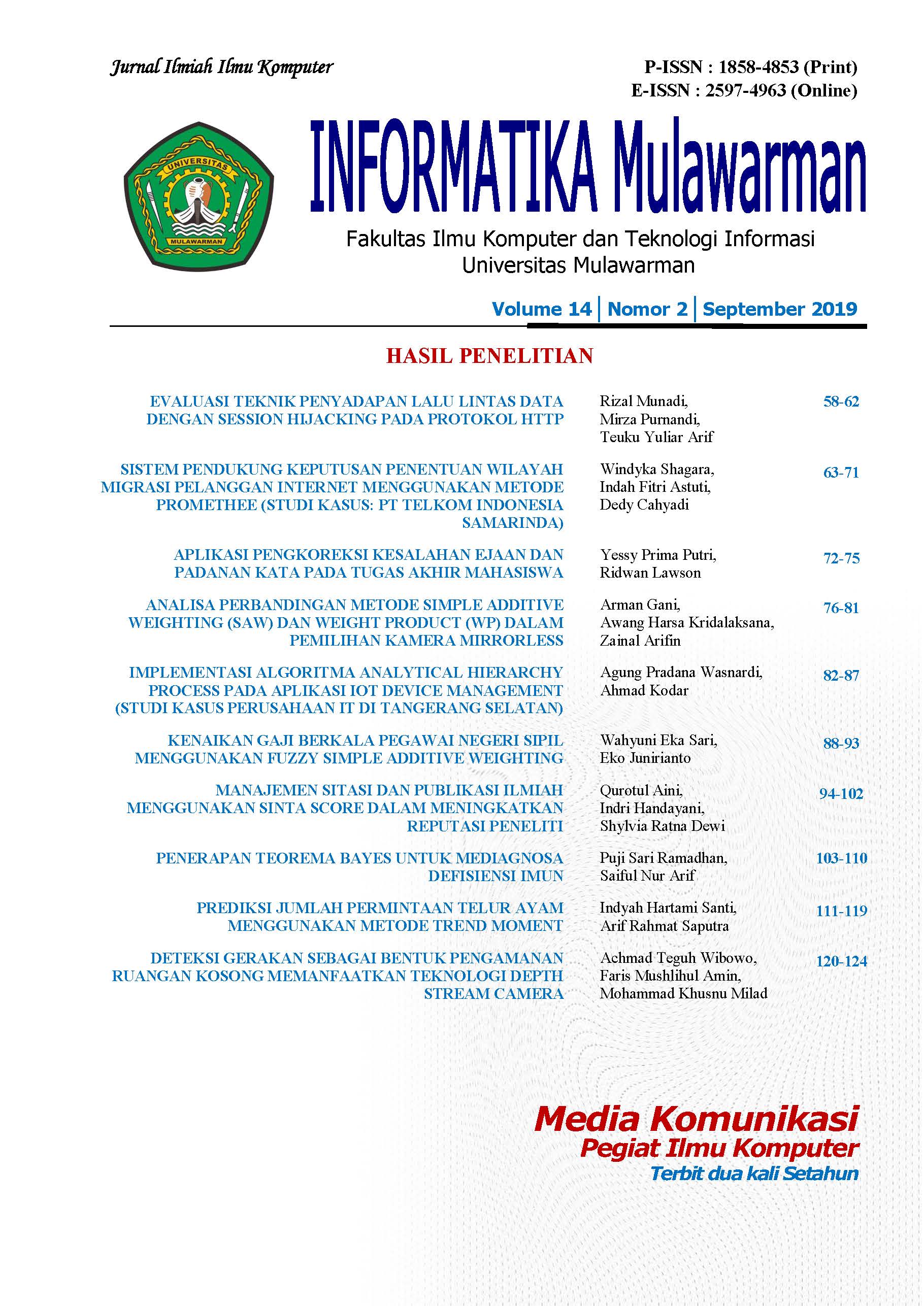
Kenaikan Gaji Berkala Pegawai Negeri Sipil Menggunakan Fuzzy Simple Additive Weighting
DOI:
https://doi.org/10.30872/jim.v14i2.2564Keywords:
Kenaikan Gaji Berkala, Fuzzy, Simple Additive Weighting, Kalimantan TimurAbstract
Penelitian ini bertujuan untuk merancang sistem dan menganalisis kenaikan gaji berkala Pegawai Negeri Sipil pemerintah provinsi Kalimantan Timur menggunakan metode Fuzzy Simple Additive Weighting (FSAW). Metode FSAW menyeleksi dan melakukan pemeringkatan pegawai yang sesuai kualifikasi untuk naik gaji berdasarkan sejumlah kriteria yang mengacu pada peraturan pemerintah. Kriteria yang dijadikan acuan untuk seleksi berkas kenaikan gaji PNS antara lain: masa kerja, penilaian SKP dua tahun terakhir, penilaian perilaku, dan hukuman disiplin. Hasil dari penelitian ini adalah aplikasi berbasis web yang dapat melakukan perhitungan dan penyeleksian kenaikan gaji PNS. Pada aplikasi berbasis web ini terdapat fasilitas seleksi pengajuan berkas kenaikan gaji, memberikan peringatan kenaikan gaji, serta menghasilkan laporan pengajuan kenaikan gaji berkala. Tiga puluh data pegawai dianalisis menggunakan metode FSAW dan diperoleh keakuratan sebesar 90% dibandingkan dengan pengambilan keputusan secara manual.
References
Badan Kepegawaian Daerah Kaltim. (2013a). Standar Operasional Kenaikan Gaji Berkala PNS Kaltim.
Badan Kepegawaian Daerah Kaltim. (2013b). Standar Operasional Kenaikan Pangkat dan Golongan PNS Kaltim.
Basri, B., & Assidiq, M. (2018). Klasifikasi Data pada Sistem Penjurusan dengan Preferensi Standar Simple Additive Weighting (PS-SAW). Jurnal Nasional Teknik Elektro Dan Teknologi Informasi (JNTETI), 6(4), 404–409. https://doi.org/10.22146/jnteti.v6i4.351
Lin, H. Y., Liao, C. J., & Chang, Y. H. (2010). Applying fuzzy simple additive weighting sistem to health examination institution location selection. Proceedings - 2010 IEEE 17th International Conference on Industrial Engineering and Engineering Management, IE and EM2010, 646–650. https://doi.org/10.1109/ICIEEM.2010.5646533
Muslihudin, M., Kurniawan, D., & Widyaningrum, I. (2017). Implementasi Model Fuzzy SAW Dalam Penilaian Kinerja Penyuluh Agama. Jurnal TAM ( Technology Acceptance Model ), 8(1), 39–44.
Negara, B. K. (1977). Peraturan Pemerintah Republik Indonesia Nomor 7 Tahun 1977 Tentang Peraturan Gaji Pegawai Negeri Sipil (Vol. 3).
Pemerintah. (2015). Peraturan Pemerintah No. 30 tahun 2015 Perubahan Ketujuh Belas Atas Peraturan Pemerintah Nomor 7 Tahun 1977 Tentang Peraturan Gaji Pegawai Negeri Sipil.
Presiden Republik Indonesia. (2007). PP No. 53 Tahun 2010 Tentang Disiplin Pegawai Negeri Sipil. Retrieved from www.kemenag.go.id
Roszkowska, E., & Kacprzak, D. (2016). The fuzzy saw and fuzzy TOPSIS procedures based on ordered fuzzy numbers. Information Sciences, 369, 564–584. https://doi.org/10.1016/j.ins.2016.07.044
Verina, Wiwi; Dewi, R. (2016). Penerapan Metode Fuzzy SAW Untuk Penyeleksian Beasiswa Bidik Misi ( Studi Kasus : Universitas Potensi Utama ). Journal Of Applied Intelligent Sistem (JAIS) UDINUS, 1(3), 167–178.
Yulianti, A. (2019). Sistem Pengambilan Keputusan dalam Penentuan Kelas Jabatan Fungsional Umum ( JFU ) Pegawai Negeri Sipil ( PNS ) Menggunakan Decision Making Sistem For Determining Class In General Functional Works Classification Of Civil Servants Using Multi. Jurnal Teknologi Informasi Dan Ilmu Komputer (JTIIK), 6(1), 63–70. https://doi.org/10.25126/jtiik.201961230
Downloads
Published
Issue
Section
License
Copyright Transfer StatementThe copyright of this article is transferred to Informatika Mulawarman : Jurnal Ilmiah Ilmu Komputer and when the article is accepted for publication. the authors transfer all and all rights into and to paper including but not limited to all copyrights in the Informatika Mulawarman. The author represents and warrants that the original is the original and that he/she is the author of this paper unless the material is clearly identified as the original source, with notification of the permission of the copyright owner if necessary. The author states that he has the authority and authority to make and carry out this task.
The author states that:
- This paper has not been published in the same form elsewhere.
- This will not be submitted elsewhere for publication prior to acceptance/rejection by this Journal.
A Copyright permission is obtained for material published elsewhere and who require permission for this reproduction. Furthermore, I / We hereby transfer the unlimited publication rights of the above paper to Informatika Mulawarman : Jurnal Ilmiah Ilmu Komputer. Copyright transfer includes exclusive rights to reproduce and distribute articles, including reprints, translations, photographic reproductions, microforms, electronic forms (offline, online), or other similar reproductions.
The author's mark is appropriate for and accepts responsibility for releasing this material on behalf of any and all coauthor. This Agreement shall be signed by at least one author who has obtained the consent of the co-author (s) if applicable. After the submission of this agreement is signed by the author concerned, the amendment of the author or in the order of the author listed shall not be accepted.
Rights / Terms and Conditions Saved
- The author keeps all proprietary rights in every process, procedure, or article creation described in Work.
- The author may reproduce or permit others to reproduce the work or derivative works for the author's personal use or for the use of the company, provided that the source and the Informatika Mulawarman copyright notice are indicated, the copy is not used in any way implying the Journal of Informatika Mulawarman (JIM) approval of the product or service from any company, and the copy itself is not offered for sale.
- Although authors are permitted to reuse all or part of the Works in other works, this does not include granting third-party requests to reprint, republish, or other types of reuse.

Informatika Mulawarman by http://e-journals.unmul.ac.id/index.php/JIM/index is licensed under a Creative Commons Attribution-ShareAlike 4.0 International License.
under the CC BY-SA license, authors and other users are able to reprint, distribute or use the material for commercial purposes so long as they give attribution to the journal Informatika Mulawarman and license the republished material under the same license.