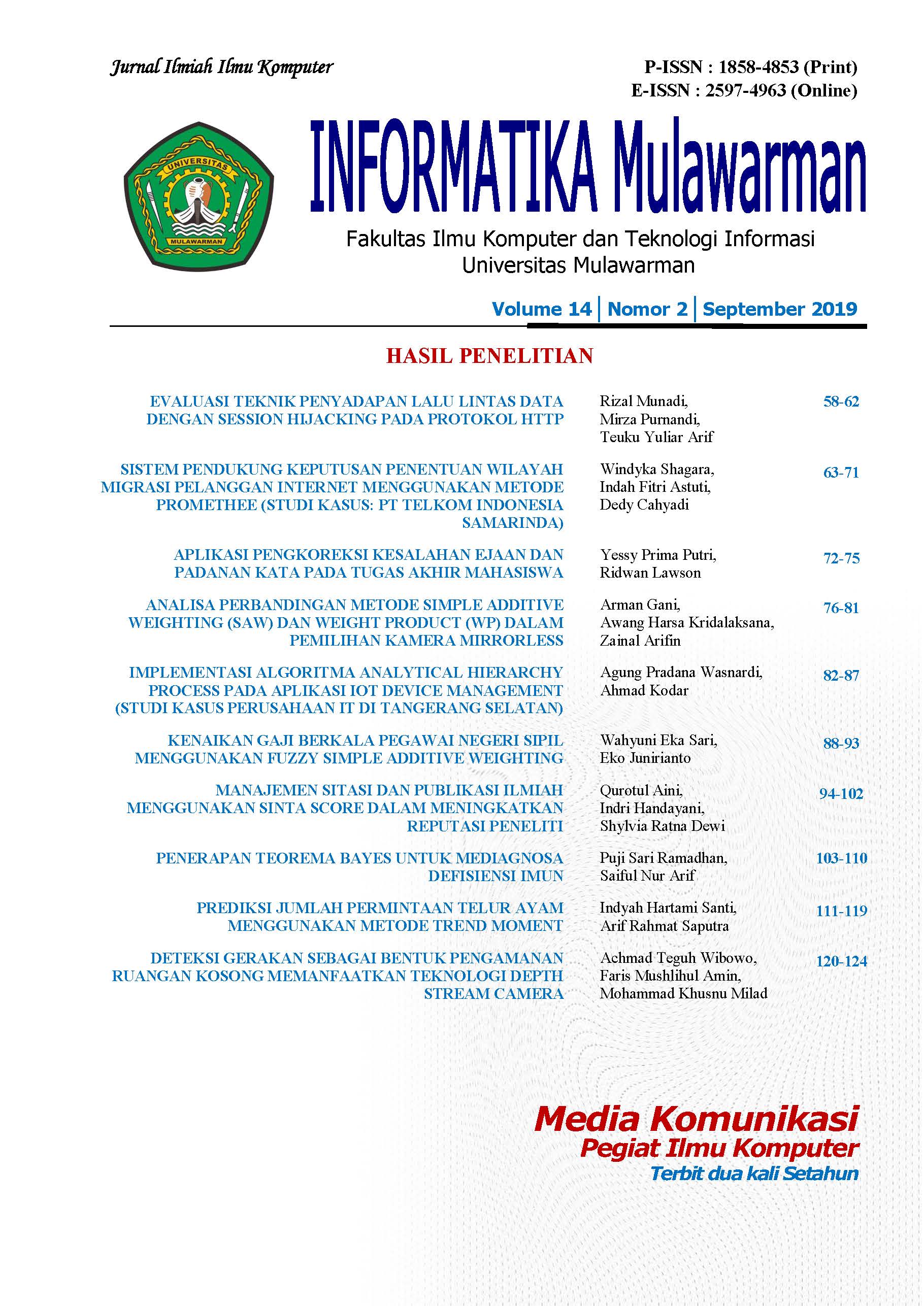
Deteksi Gerakan Sebagai Bentuk Pengamanan Ruangan Kosong Memanfaatkan Teknologi Depth Stream Camera
DOI:
https://doi.org/10.30872/jim.v14i2.1989Keywords:
Depth Stream Camera, Pixel, HCIAbstract
Dalam penelitian ini, membahas sistem pengamanan ruangan kosong yang tidak ada aktifitas manusia didalamnya. Ruangan kosong bisa berupa ruangan penting untuk menyimpan dokumen atau barang yang dianggap penting dan dikhawatirkan terjadi pencurian barang atau orang yang memasuki ruangan tanpa ijin. Cara kerja sistem ini menempatkan kamera depth stream kedalam ruangan kosong tersebut kemudian aplikasi mengambil nilai per pixel ruangan tersebut yang disimpan kedalam bentuk array. Berikutnya nilai dari array yang didapat akan dijumlah dan diberi margin error sekitar 2 % untuk mendapatkan nilai batas atas dan batas bawah dari nilai pixel yang didapat. Setelah menetukan parameter batas atas dan batas bawah nilai pixel, kamera akan melakukan streaming gambar dari ruangan yang sudah dipasangi kamera depth stream sehingga mendapatkan nilai pixel secara realtime yang ditampung ke dalam array kedua dan menjumlah total nilai yang ditampung dari array kedua. Lalu nilai penjumlahan array kedua tersebut dibandingkan dengan nilai batas atas dan batas bawah yang didapat dari proses sebelumnya. Jika terdapat gerakan otomatis jumlah total array kedua dapat lebih atau kurang dari batas yang ditentukan, sehingga aplikasi dapat memberi pesan kepada pengguna jika ada gerakan didalam ruang tersebut. Sehingga prinsip dari Human Computer Interacion (HCI) yaitu membuat interaksi manusia dengan komputer terjadi seefisien mungkin dapat tercapai.References
Castells, M. (2013). Informationalism, networks, and the network society: a theoretical blueprint. The Network Society. https://doi.org/10.4337/9781845421663.00010
Darimi, I. (2008). Teknologi Informasi Dan Komunikasi Sebagai Media Pembelajaran Pendidikan Agama Islam Efektif. Jurnal Pendidikan Teknologi Informasi, 36(1–4), 1–2. https://doi.org/10.1007/s11068-008-9037-4
Jarrett Webb, J. A. (2012). Beginning Kinect Programming with the Microsoft Kinect SDK (1st ed.). New York: Apress.
Kurniawan, A. (2019). 17 Definisi, Pengertian Teknologi Menurut Para Ahli Dan Perkembangannya.
Loehr, D. (2004). Gesture and Intonation (Ph.D Thesi). Washington, D.C.: Georgetown University.
Majid, K. (2016). Pengertian Pixel.
Nafi’an, M. I., Chrisnanto, Y. H., & Uriawan, W. (2016). PENERAPAN AUGMENTED REALITY UNTUK EKSPLORASI FASILITAS DI UNJANI BERBASIS HUMAN COMPUTER INTERACTION ( HCI ), 2016(Sentika), 18–19.
Ngafifi, M. (2014). Kemajuan Teknologi Dan Pola Hidup Manusia Dalam Perspektif Sosial Budaya. Jurnal Pembangunan Pendidikan: Fondasi Dan Aplikasi, 2(1), 33–47. https://doi.org/10.21831/jppfa.v2i1.2616
Pacey, A. (1983). The culture of technology. Michigan: MIT Press.
Toynbee, A. J. (2004). Sejarah Umat Manusia (Mankind and Mother Earth): A Narrative History of the World. Yogyakarta: Pustaka Pelajar.
Wibowo, A. T., Yudaningtyas, E., & Sunaryo. (2013). Teknologi Natural User Interface Menggunakan Kinect Sebagai Pemicu Kerja Perangkat Keras Berbasis Fuzzy Inference System. Jurnal EECIS, 7(1), 1–6.
Downloads
Published
Issue
Section
License
Copyright Transfer StatementThe copyright of this article is transferred to Informatika Mulawarman : Jurnal Ilmiah Ilmu Komputer and when the article is accepted for publication. the authors transfer all and all rights into and to paper including but not limited to all copyrights in the Informatika Mulawarman. The author represents and warrants that the original is the original and that he/she is the author of this paper unless the material is clearly identified as the original source, with notification of the permission of the copyright owner if necessary. The author states that he has the authority and authority to make and carry out this task.
The author states that:
- This paper has not been published in the same form elsewhere.
- This will not be submitted elsewhere for publication prior to acceptance/rejection by this Journal.
A Copyright permission is obtained for material published elsewhere and who require permission for this reproduction. Furthermore, I / We hereby transfer the unlimited publication rights of the above paper to Informatika Mulawarman : Jurnal Ilmiah Ilmu Komputer. Copyright transfer includes exclusive rights to reproduce and distribute articles, including reprints, translations, photographic reproductions, microforms, electronic forms (offline, online), or other similar reproductions.
The author's mark is appropriate for and accepts responsibility for releasing this material on behalf of any and all coauthor. This Agreement shall be signed by at least one author who has obtained the consent of the co-author (s) if applicable. After the submission of this agreement is signed by the author concerned, the amendment of the author or in the order of the author listed shall not be accepted.
Rights / Terms and Conditions Saved
- The author keeps all proprietary rights in every process, procedure, or article creation described in Work.
- The author may reproduce or permit others to reproduce the work or derivative works for the author's personal use or for the use of the company, provided that the source and the Informatika Mulawarman copyright notice are indicated, the copy is not used in any way implying the Journal of Informatika Mulawarman (JIM) approval of the product or service from any company, and the copy itself is not offered for sale.
- Although authors are permitted to reuse all or part of the Works in other works, this does not include granting third-party requests to reprint, republish, or other types of reuse.

Informatika Mulawarman by http://e-journals.unmul.ac.id/index.php/JIM/index is licensed under a Creative Commons Attribution-ShareAlike 4.0 International License.
under the CC BY-SA license, authors and other users are able to reprint, distribute or use the material for commercial purposes so long as they give attribution to the journal Informatika Mulawarman and license the republished material under the same license.