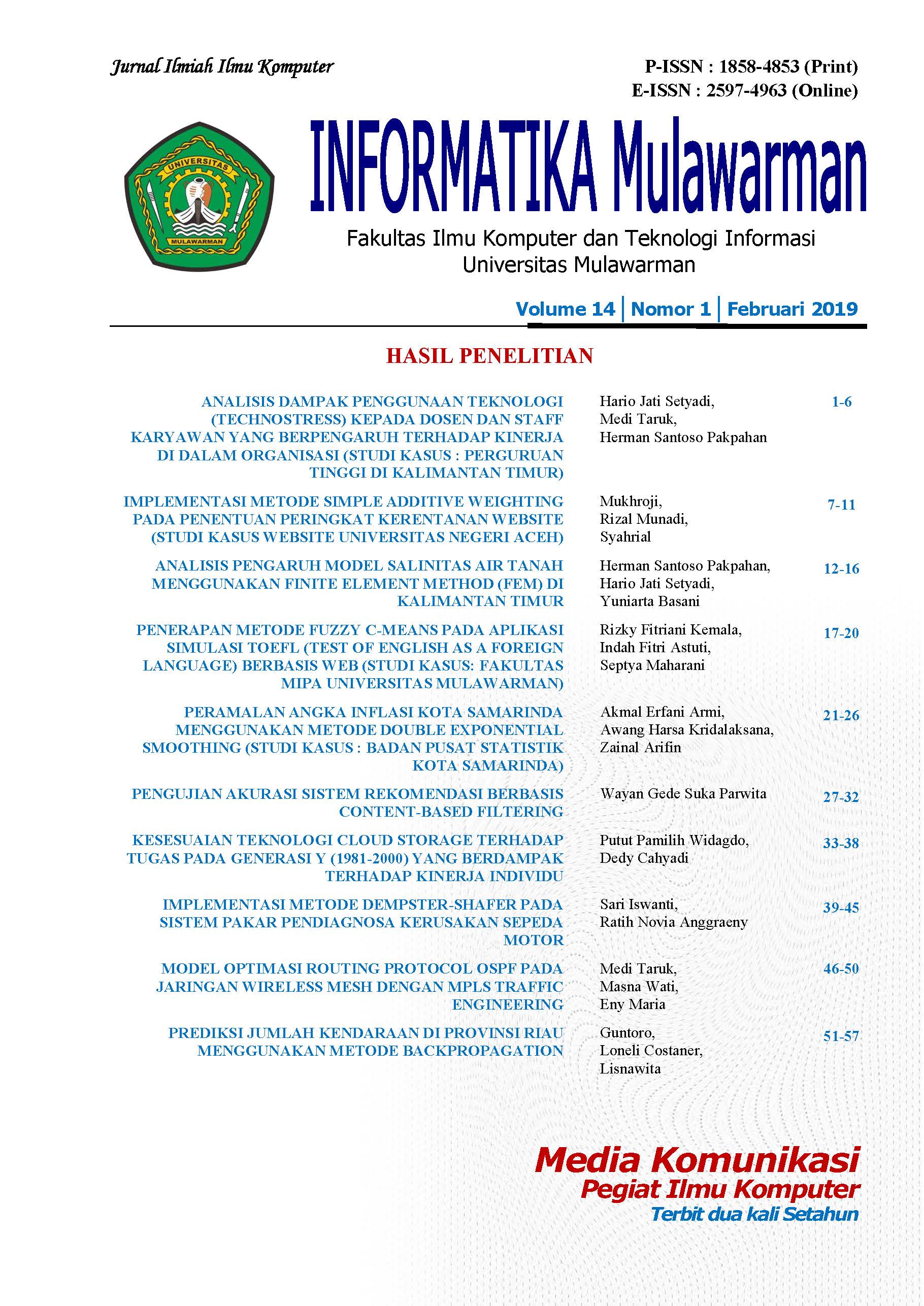
Kesesuaian Teknologi Cloud Storage Terhadap Tugas Pada Generasi Y (1981-2000) Yang Berdampak Terhadap Kinerja Individu
DOI:
https://doi.org/10.30872/jim.v14i1.1853Keywords:
Kesesuaian Teknologi Terhadap Tugas, Generasi Y, Kinerja Individu, Cloud Storage.Abstract
Generasi merupakan sekelompok individu yang lahir pada rentang kelahiran yang sama, di mana pada masa itu mempunyai keunikan yang terbentuk dari pengalaman, sejarah atau zaman yang sama. Organisasi memiliki generasi pengguna dengan rentang usia yang beragam, sehingga teknologi cloud storage yang digunakan juga harus memiliki kesesuaian, fleksibilitas, dan kemudahan dalam membantu menyelesaikan tugas-tugas. Perkembangan teknologi yang semakin pesat menyebabkan Generasi Y (1981 – 2000) tumbuh dan berkembang dalam iklim sangat kental dengan teknologi dan serbuan informasi yang serba cepat dan canggih. Generasi Y mampu memanfaatkan teknologi untuk berkembang dengan menjadikan teknologi sebagai kemudahan dalam bekerja. Penelitian ini bertujuan membuktikan hubungan faktor kesesuaian teknologi cloud storage terhadap tugas (task technology fit) yang mempengaruhi penggunaan (utilization) dan dampaknya terhadap kinerja individu (individual performance) pada Generasi Y pada perguruan tinggi di Kalimantan Timur. Penelitian ini menggunakan metode PLS-SEM dengan melibatkan 257 responden dari Generasi Y pada Perguruan Tinggi di Kalimantan Timur. Data diolah menggunakan SmartPLS versi 3.2. Hasil penelitian menunjukkan secara empiris model mampu menjelaskan 61% dari varians kinerja individu pada generasi Y dalam menggunakan teknologi cloud storage pada Perguruan Tinggi di Kalimantan Timur. Pada Faktor kesesuaian teknologi terhadap tugas (task technology fit) merupakan faktor yang mempengaruhi generasi y dalam penggunaan teknologi cloud storage. Kemudian faktor kesesuaian teknologi terhadap tugas (task technology fit) dan penggunaan (utilization) merupakan faktor yang memiliki hubungan positif berpengaruh signifikan terhadap peningkatan kinerja individu (individual performance) pada generasi y dalam menggunakan teknologi cloud storage pada perguruan tinggi di Kalimantan Timur. Berdasarkan hasil penelitian membuktikan bahwa semakin baik kesesuaian teknologi cloud storage yang digunakan terhadap tugas-tugas pada generasi y akan mempengaruhi dalam meningkatkan penggunaan dan berdampak terhadap kinerja individu.References
Balbudhe, O. P. (2013). Cloud storage Reference Model for Cloud Computing. India.
Chin, W. W. (1998). The partial least squares approachto structural equation modelling. In G. A. Marcoulides (Ed.), Modern Methods for Business Research. In Modern Methods for Business Research (pp. 295–336).
Crampton, S. M., & Hodge, J. W. (2009). Generation Y : Unchartered Territory. Journal of Business & Economics Research, 7(4), 1–6. https://doi.org/10.1080/02723638.2013.778647
D’Ambra, J., & Wilson, C. S. (2004). Explaining perceived performance of the World Wide Web: uncertainty and the task-technology fit model. Internet Research, 14(4), 294–310.
Eisner. (2005). Managing Generation Y. In SAM 2005 International Business Confrence Proceedings (pp. 4–15). New Jersey.
Fark, R. F., & Miller, N. B. (1992). A Primer for Soft Modeling. University of Akron Press.
Fornell, C., & Larcker, D. F. (1981). Evaluating structural equation models with unobservable variables and measurement error. Journal of Marketing Research, 18, 39–50.
Goodhue, D., & Thompson, R. (1995). Task-Technology Fit and Individual Performance. MIS Quarterly, 19(2), 213–236. https://doi.org/10.2307/249689
Gursoy, D., Maier, T. A., & Chi, C. G. (2008). Generational differences: An examination of work values and generational gaps in the hospitality
workforce. International Journal of Hospitality Management, 27(3), 448–458. https://doi.org/10.1016/j.ijhm.2007.11.002
Hair, J. F., Ringgle, C. M., & Sarstedt, M. (2011). PLS-SEM: Indeed a Silver Bullet. Journal of Marketing Theory and Practice, 19(2), 139–151.
Hair, J. F., Sarstedt, M., Ringle, C. M., & Mena, J. A. (2012). An assessment of the use of partial least squares structural equation modeling in marketing research, 414–433. https://doi.org/10.1007/s11747-011-0261-6
Hong, S. J., Lui, C. S., Hahn, J., Moon, J. Y., & Kim, T. G. (2013). How old are you really? Cognitive age in technology acceptance. In Decision Support Systems 56 (pp. 122–130).
Hulland, J. (1999). Use of Partial Least Squares (PLS) in strategic management research: a review of four recent studies. Strategic Management Journal, 20, 195–204.
Igbaria, M., & Tan, M. (1997). The consequences of information technology acceptance on subsequent individual performance. Information and Management, 32(3), 113–121. https://doi.org/10.1016/S0378-7206(97)00006-2
Kearns, J. L., & Venugopal. (2007). Understanding Generation Y in The Workplace “What Does it Take to Hire And Retain The Talent of The New Generation ?”
Widagdo, P. P., & Susanto, T. D. (2015). Pengaruh Kesesuaian Teknologi Pada Tugas (Task Technology Fit) Terhadap Kinerja Individu Dalam Menggunakan Teknologi Informasi (Studi Kasus: Universitas Mulawarman). Prosiding Seminar Nasional Manajemen Teknologi XXIII Program Studi MMT-ITS Surabaya.
Widagdo, P. P. (2016). Pengaruh Kesesuaian Teknologi Terhadap Tugas Terhadap Kinerja Individu Pada Generasi Baby Boomers (1945-1964) Dalam Menggunakan Teknologi Informasi (Studi Kasus: Universitas Mulawarman). Informatika Mulawarman: Jurnal Ilmiah Ilmu Komputer, 11(2), 54-60.
Widagdo, P. P., & Susanto, T. D. (2016, October). The effect of task technology fit toward individual performance on the Generation X (1956–1980) using information technology. In 2016 2nd International Conference on Science in Information Technology (ICSITech) (pp. 181-186). IEEE. https://doi.org/10.1109/ICSITech.2016.7852630
Widagdo, P. P. (2018). Pengaruh Task Technology Fit Pada Generasi X (1965-1980) Dalam Menggunakan Teknologi Cloud Storage. JURNAL REKAYASA TEKNOLOGI INFORMASI, 2(2), 163-171.
Wu, J., Ping, L., Ge, X., Wang, Y., & Fu, J. (2010). Cloud Storage as the Infrastructure of Cloud Computing. In Intelligent Computing and Cognitive Informatics, International Conference on(ICICCI) (pp. 380–383). Kuala Lumpur. https://doi.org/10.1109/ICICCI.2010.119
Yen, D. C., Wu, C. S., Cheng, F. F., & Huang, Y. W. (2010). Determinants of Users Intention to Adopt wireless tecnology : An Empirical Study by Integrating TTF with TAM. Computers in Human Behavior, 26, 906–915.
Downloads
Published
Issue
Section
License
Copyright Transfer StatementThe copyright of this article is transferred to Informatika Mulawarman : Jurnal Ilmiah Ilmu Komputer and when the article is accepted for publication. the authors transfer all and all rights into and to paper including but not limited to all copyrights in the Informatika Mulawarman. The author represents and warrants that the original is the original and that he/she is the author of this paper unless the material is clearly identified as the original source, with notification of the permission of the copyright owner if necessary. The author states that he has the authority and authority to make and carry out this task.
The author states that:
- This paper has not been published in the same form elsewhere.
- This will not be submitted elsewhere for publication prior to acceptance/rejection by this Journal.
A Copyright permission is obtained for material published elsewhere and who require permission for this reproduction. Furthermore, I / We hereby transfer the unlimited publication rights of the above paper to Informatika Mulawarman : Jurnal Ilmiah Ilmu Komputer. Copyright transfer includes exclusive rights to reproduce and distribute articles, including reprints, translations, photographic reproductions, microforms, electronic forms (offline, online), or other similar reproductions.
The author's mark is appropriate for and accepts responsibility for releasing this material on behalf of any and all coauthor. This Agreement shall be signed by at least one author who has obtained the consent of the co-author (s) if applicable. After the submission of this agreement is signed by the author concerned, the amendment of the author or in the order of the author listed shall not be accepted.
Rights / Terms and Conditions Saved
- The author keeps all proprietary rights in every process, procedure, or article creation described in Work.
- The author may reproduce or permit others to reproduce the work or derivative works for the author's personal use or for the use of the company, provided that the source and the Informatika Mulawarman copyright notice are indicated, the copy is not used in any way implying the Journal of Informatika Mulawarman (JIM) approval of the product or service from any company, and the copy itself is not offered for sale.
- Although authors are permitted to reuse all or part of the Works in other works, this does not include granting third-party requests to reprint, republish, or other types of reuse.

Informatika Mulawarman by http://e-journals.unmul.ac.id/index.php/JIM/index is licensed under a Creative Commons Attribution-ShareAlike 4.0 International License.
under the CC BY-SA license, authors and other users are able to reprint, distribute or use the material for commercial purposes so long as they give attribution to the journal Informatika Mulawarman and license the republished material under the same license.