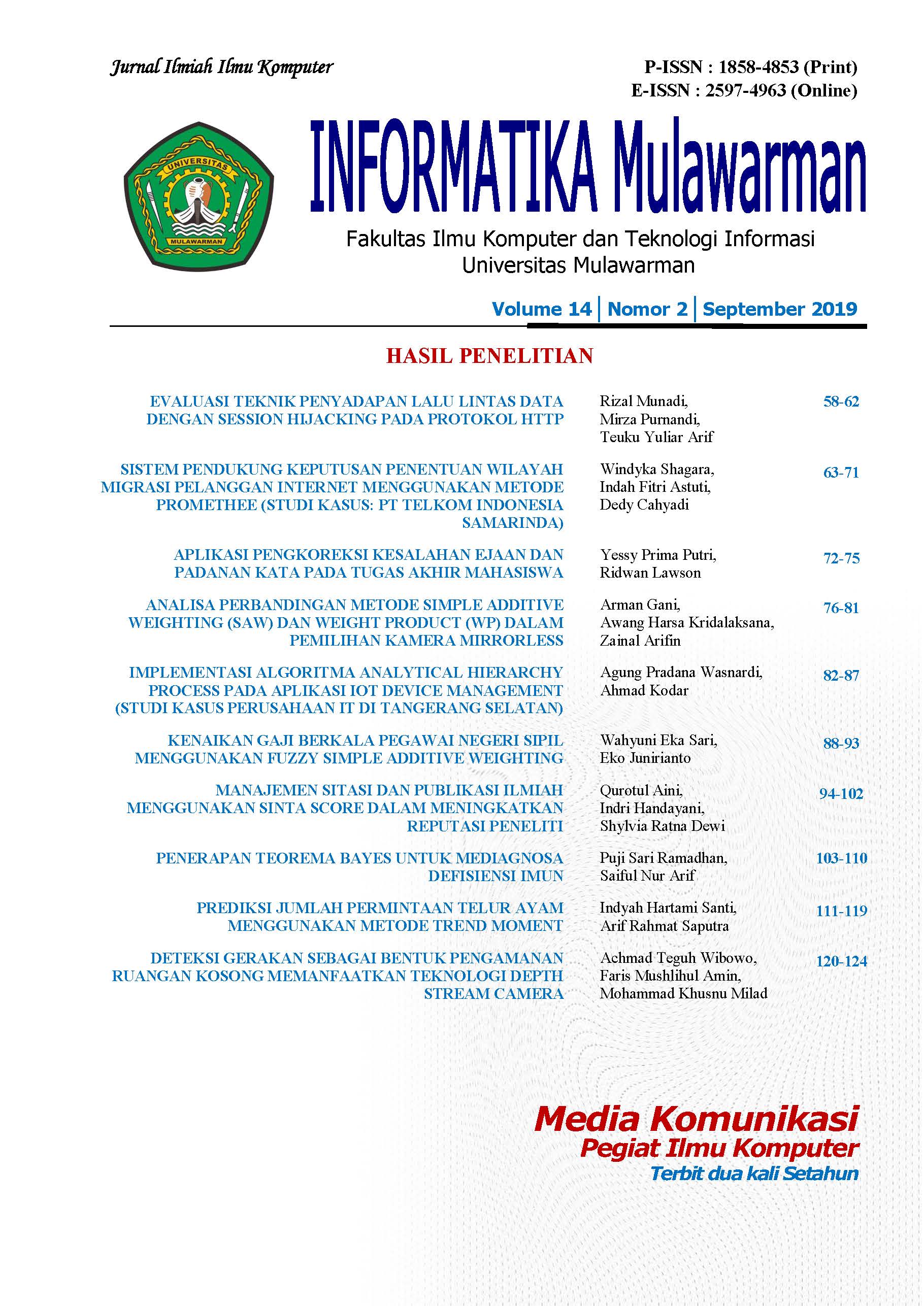
Manajemen Sitasi dan Publikasi Ilmiah Menggunakan SINTA Score Dalam Meningkatkan Reputasi Peneliti
DOI:
https://doi.org/10.30872/jim.v14i2.1815Keywords:
Google Scholar, Sitasi, H-IndexAbstract
Perkembangan teknologi seperti sekarang ini, sudah sangat banyak mahasiswa atau dosen yang melakukan menulis dokumen atau artikel secara digital. Namun, masih mengalami banyak kendala saat mencari sumber referensi yang sah dan mengetahui apakah tulisan tersebut mengandung unsur plagiarisme atau tidak. Oleh karena itu Google mendukung dengan adanya sistem Google Scholar atau Google Cendekia, Google juga mendukung dengan adanya Sitasi atau Kutipan (Daftar Pustaka), tujuannya untuk mengidentifikasi: 1) jumlah sitasi dan H-Index yang dimiliki oleh dosen pada Perguruan Tinggi, 2) jumlah score dan ranking Perguruan Tinggi pada SINTA (Science and Technology Index) Ristekdikti. mengutip sebuah tulisan dari artikel lain merupakan salah satu bentuk komunikasi ilmiah yang dilakukan penulis atau peneliti. Dalam penelitian ini analisis kutipan digunakan sebagai menganalisa semua kutipan dimana menunjukkan jenis sumber informasi yang digunakan oleh mahasiswa dalam menulis jurnal tersebut sebagai hasil penelitiannya kemudian penelitian berikut ini menggunakan dua metode yaitu metode Mind Mapping dan Analisa SWOT. setelah melakukan penelitian dan melaksanakan strategi penelitian ini akan menghasilkan meningkatkan jumlah sitasi dan H-Index dosen pada Google Scholar yang secara otomatis dapat juga meningkatkan affiliations penulis pada Perguruan Tinggi di Google Scholar, dosen yang memiliki verified authors pada SINTA (Science and Technology Index) Ristekdikti dapat berkontribusi dalam meningkatkan ranking serta jumlah score Perguruan Tinggi pada SINTA (Science and Technology Index) Ristekdikti. Diharapkan, dengan adanya penelitian ini mahasiswa dan dosen mampu meningkat kan sitasi dan H-index pada artikel yang di publikasi sehingga dapat memberikan kontribusi dalam peningkatan kualitas pada Perguruan Tinggi.
References
Jayashree, R., & Christy, A. (2018). Enhanced User-Driven Ranking System with Splay Tree.TELKOMNIKA (Telecommunication Computing Electronics and Control), 16(2).
Bornmann, L., & Daniel, H. D. (2009). The state of h index research. EMBO reports, 10(1), 2-6.
Wahyudin, D., Aziz, W. D. I., Rahmatullah, S., Irwansyah, F. S., Sugilar, H., Maylawati, D. S. A., & Suhendi, H. Y. (2018). Analisis Ranking Produktivitas Publikasi Ilmiah Berbasis h-Index Google Scholar.
Zhang, C. T. (2013). The h’-index, effectively improving the h-index based on the citation distribution. PloS one, 8(4), e59912.
Garfield, E. (1970). Citation indexing for studying science. Nature, 227(5259), 669-671.
Bakkalbasi, N., Bauer, K., Glover, J., & Wang, L. (2006). Three options for citation tracking: Google Scholar, Scopus and Web of Science. Biomedical digital libraries, 3(1), 7.
Thakral, S., Bansal, D., & Chakarvarti, S. K. (2016). Implementation and Analysis of Reversible logic Based Arithmetic Logic Unit. TELKOMNIKA (Telecommunication Computing Electronics and Control), 14(4), 1292-1298.
Hirsch, J. E. (2005). An index to quantify an individual's scientific research output. Proceedings of the National academy of Sciences of the United States of America, 102(46), 16569.
Istadi, I. (2015, December). Strategi Pengembangan dan Indeksasi Jurnal Bereputasi Internasional. In Makalah Workshop Pengelolaan Jurnal cecara Elektronik Menuju Indeksasi Internasional (Vol. 3).
Jensen, H. W. (2001). Realistic image synthesis using photon mapping. AK Peters/CRC Press.
Petras, I. (2000). The fractional-order controllers: Methods for their synthesis and application. arXiv preprint math/0004064.
Rahardja, U., Tiara, K., & Rosalinda, I. A. (2016). Pemanfaatan Google Scholar Dan Citation Dalam Memenuhi Kebutuhan Pembuatan Skripsi Mahasiswa Pada Perguruan Tinggi. Technomedia Journal, 1(1), 95-113.
Garfield, E. (1972, November). Citation analysis as a tool in journal evaluation. American Association for the Advancement of Science.
Lawrence, S., Giles, C. L., & Bollacker, K. (1999). Digital libraries and autonomous citation indexing. Computer, 32(6), 67-71.
Handayani, I., Aini, Q., & Azis, P. A. (2018). Pemanfaatan Generate Penjadwalan Sidang Pada PESSTA+ Berbasis Yii Framework Di Perguruan Tinggi. Technomedia Journal, 2(2), 1-13.
Harhoff, D., Narin, F., Scherer, F. M., & Vopel, K. (1999). Citation frequency and the value of patented inventions. The review of Economics and Statistics, 81(3), 511-515.
Lazaridis, T. (2010). Ranking university departments using the mean h-index. Scientometrics, 82(2), 211-216.
Harzing, A. W. K., & Van der Wal, R. (2008). Google Scholar as a new source for citation analysis. Ethics in science and environmental politics, 8(1), 61-73.
Eysenbach, G. (2006). Citation advantage of open access articles. PLoS biology, 4(5), e157.
Ale Ebrahim, N., Salehi, H., Embi, M. A., Habibi, F., Gholizadeh, H., Motahar, S. M., & Ordi, A. (2013). Effective strategies for increasing citation frequency.
Li, J., Burnham, J. F., Lemley, T., & Britton, R. M. (2010). Citation analysis: Comparison of web of science®, scopus™, SciFinder®, and google scholar. Journal of electronic resources in medical libraries, 7(3), 196-217.
Rahardja, U., Harahap, E. P., & Dewi, S. R. (2019). The Strategy of Enhancing Article Citation and H-Index on SINTA to Improve Tertiary Reputation. TELKOMNIKA (Telecommunication Computing Electronics and Control), 17(1).
Rahardja, U. (2009, May). Artificial informatics. In Industrial Electronics and Applications, 2009. ICIEA 2009. 4th IEEE Conference on (pp. 3064-3067). IEEE.
Warsito, A. B., & Yusup, M. (2014). Kajian Yii Framework dalam Pengembangan Website Perguruan Tinggi. CCIT Journal 3 (STMIK RAHARJA), 7(3), 437-451.
Venable, H. D. (1983, March). The K factor: A new mathematical tool for stability analysis and synthesis. In Proc. Powercon (Vol. 10, pp. H1-1).
Rahardja, U., Aini, Q., & Harahap, E. P. Manajemen Sistem Gamifikasi Sebagai Inovasi Pembelajaran.
Diveev, A., & Sofronova, E. (2012). The network operator method for search of the most suitable mathematical equation. In Bio-inspired computational algorithms and their applications. InTech.
Aini, Q., Rahardja, U., Moeins, A., & Apriani, D. M. (2018). Penerapan Gamifikasi pada Sistem
Informasi Penilaian Ujian Mahasiswa Untuk Meningkatkan Kinerja Dosen. Jurnal Informatika Upgris,4(1).
Istiana, P., & Purwaningsih, S. (2016). Pemanfaatan E-journal oleh Mahasiswa: Kajian Analisis Sitasi Terhadap Tesis Mahasiswa Klaster Saintek Universitas Gadjah Mada. Berkala Ilmu Perpustakaan dan Informasi, 12(2), 150-158.
Grossmann, I. E., Caballero, J. A., & Yeomans, H. (2000). Advances in mathematical programming for the synthesis of process systems. Latin American Applied Research, 30(4), 263-284.
Taruk, M. (2018). Evaluasi Kinerja Varian Algoritma Congestion Control Pada Teknologi LTE (Long Term Evolution). Informatika Mulawarman: Jurnal Ilmiah Ilmu Komputer, 13(2), 84-87.
Downloads
Published
Issue
Section
License
Copyright Transfer StatementThe copyright of this article is transferred to Informatika Mulawarman : Jurnal Ilmiah Ilmu Komputer and when the article is accepted for publication. the authors transfer all and all rights into and to paper including but not limited to all copyrights in the Informatika Mulawarman. The author represents and warrants that the original is the original and that he/she is the author of this paper unless the material is clearly identified as the original source, with notification of the permission of the copyright owner if necessary. The author states that he has the authority and authority to make and carry out this task.
The author states that:
- This paper has not been published in the same form elsewhere.
- This will not be submitted elsewhere for publication prior to acceptance/rejection by this Journal.
A Copyright permission is obtained for material published elsewhere and who require permission for this reproduction. Furthermore, I / We hereby transfer the unlimited publication rights of the above paper to Informatika Mulawarman : Jurnal Ilmiah Ilmu Komputer. Copyright transfer includes exclusive rights to reproduce and distribute articles, including reprints, translations, photographic reproductions, microforms, electronic forms (offline, online), or other similar reproductions.
The author's mark is appropriate for and accepts responsibility for releasing this material on behalf of any and all coauthor. This Agreement shall be signed by at least one author who has obtained the consent of the co-author (s) if applicable. After the submission of this agreement is signed by the author concerned, the amendment of the author or in the order of the author listed shall not be accepted.
Rights / Terms and Conditions Saved
- The author keeps all proprietary rights in every process, procedure, or article creation described in Work.
- The author may reproduce or permit others to reproduce the work or derivative works for the author's personal use or for the use of the company, provided that the source and the Informatika Mulawarman copyright notice are indicated, the copy is not used in any way implying the Journal of Informatika Mulawarman (JIM) approval of the product or service from any company, and the copy itself is not offered for sale.
- Although authors are permitted to reuse all or part of the Works in other works, this does not include granting third-party requests to reprint, republish, or other types of reuse.

Informatika Mulawarman by http://e-journals.unmul.ac.id/index.php/JIM/index is licensed under a Creative Commons Attribution-ShareAlike 4.0 International License.
under the CC BY-SA license, authors and other users are able to reprint, distribute or use the material for commercial purposes so long as they give attribution to the journal Informatika Mulawarman and license the republished material under the same license.