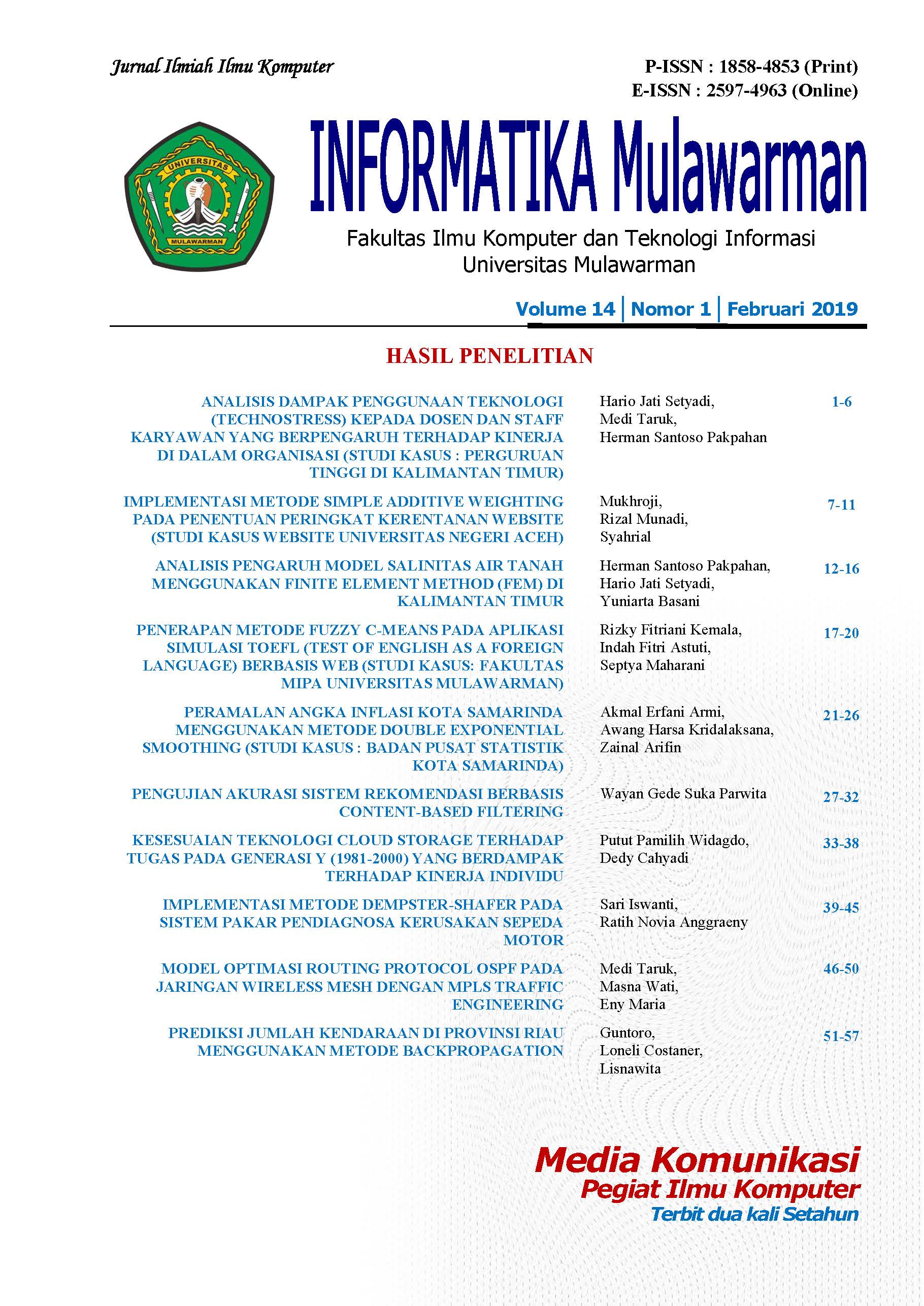
Analisis Dampak Penggunaan Teknologi (Technostress) Kepada Dosen dan Staff Karyawan Yang Berpengaruh Terhadap Kinerja di Dalam Organisasi (Studi Kasus : Perguruan Tinggi di Kalimantan Timur)
DOI:
https://doi.org/10.30872/jim.v14i1.1792Keywords:
Technostress, Kinerja, TIKAbstract
Salah satu dampak negatif dari TIK adalah Stress yang ditimbulkan karena ketidakmampuan beradaptasi dengan lingkungan yang penuh dengan teknologi, dimana prilaku tersebut dapat mempengaruhin mental dan tingkah laku dalam bekerja yang berdampak menurunnya kinerja . Technostress secara umum dapat didefinisikan sebagai tekanan mental yang di alami karyawan karena penggunaan TIK di tempat kerja (Weil & Rosen, 1997). Penelitian ini bertujuan untuk membuktikan dari Teori penelitian sebelumnya tentang analisis dampak penyebab technostress Dosen dan staff karyawan yang berpengaruh terhadap kinerja di organisasi. Hal ini dilakukan dengan cara mengidentifikasi usia dan factor utama pemicu technostress di dalam organsiasi terhadap penggunaan TIK yang ada. Dimana penelitian ini menggunakan metode pengambilan kuesioner dan wawancara secara langsung. Berdasarkan hasil penelitian ternyata perbedaan usia tidak bepengaruh signifikan terhadap TechnoStress. Karena variabel tersebut di uji kepada model Penelitian ini hanya mayoritas responden usia 20-30. Kemudian hasil penelitian ini juga diperoleh hubungan antara Technostress terhadap berpengaruh secara signifikan dengan nilai T-Statistik 4.424 dengn tingkat error 0.05 atau dengan tingkat keyakinan 95% hipotesis penelitian dapat diterima.
References
Chin, W. W., & Lee, M. K. (2000). A proposed Model and Measurement Instrument For The Formation Of IS Satisfaction : The Case End User Computing Satisfaction. 2000 ICIS Conference Proceedings, 553-563.
Cohen, J., Cohen, P., West, S. G., & Aiken, L. S. (2003). Applied Multiple Regression/Correlation Analysis for the Behavioral Sciences(Third ed.): Lawrence Erlbaum Associates. New Jersey, London: Publishers, Mahwah.
Çoklar, A. N., & Sahin, Y. L. (2011). Technostress Levels of Social Network Users Based on ICTs in Turkey. European Journal of Social Sciences – Volume 23, Number 2.
Setyadi, H. J., Widagdo, P. P., & Susanto, T. D. (2017, October). Cognitive age and chronological age of the technostress that effect on satisfaction, performance, and intention of continue the use of information technology in the university. In Science in Information Technology (ICSITech), 2017 3rd International Conference on (pp. 330-335). IEEE.
Fugseth, A. M., & Sorebo, O. (2014). The effect of technostress within the context of employee use of ICT. Computer in Human Behavior 40, 161-170.
Ghozali, I., & Latan, H. (2015). Partial Least Squares Konsep, Teknik Dan Aplikasi Menggunakan Program SmartPLS 3.0 untuk Penelitian empiris . Semarang: Badan Penerbit Universitas Diponegoro Semarang.
Gunasekaran, A. K. (2007). “Performance measures and metrics in logistics and supply chain management: a review of recent literature (1995-2004) for research and application”. International Journal of Production Research, Vol. 45 No. 12, 2819-2840.
Hair, J. F., Hult, G. T., Ringle, C. M., & Sarstedt, M. (2014). A primer on partial least squares structural equation modeling (PLS-SEM). Thousand Oaks : Sage.
Hong, S.-J., Lui, C. S., moon, J. Y., & Kim, T. G. (2013). How old are you really ? cognitive age in technology acceptance. Decision Support System 56, 122-130.
Hung, W.-H., Chen, K., & Lin, C.-P. (2015). Does the proactive personality mitigate the adverse effect of technostress on productivity in the mobile environment. Telematics and Informatics 32, 373-83.
Ibrahim, H., Yusoff, Y. M., & Othman, N. Z. (2014). The Influence of Technostress and Organizational-Is Related Support on User Satisfaction in Government Organizations: A Proposed Model and Literature Review. Information Management and Business Review Vol. 6, No. 2, 63-71.
Jenna, R. K., & Mahanti, P. K. (2014). An Empirical study of Technostress among Indian Academicians. International Journal of Education and Learning vol.3 no.2, 1-10.
Jogiyanto. (2008). Metodologi Penelitian Sistem Informasi. Yogyakarta: Adni Publisher
Moullin, M. (2003). Defining Performance Measurement . Perspectives on Performance 2(2): 3.
Nudurupati, S. S., Bititci , U. S., Kumar , V., & Chan , F. T. (2011). State of the art literature review on performance measurement. Computers & Industrial Engineering 60, 279–290.
Ringle, C. M., Wende, S., dan Becker, J.-M. 2015. "SmartPLS 3." Boenningstedt: SmartPLS GmbH, http://www.smartpls.com.
Rivai , V. (2008). Performance Appraisal, Edisi Kedua. Jakarta: Penerbit PT.Raja Grafindo Persada.
Simamora, H. (1995). Manajemen Sumber Daya manusia,Edisi Kesatu, Cetakan Pertama. Yogyakarta: Badan Penerbit STIE.
Tarafdar, M., Tu, Q., Ragu-Nathan, & Rhagu-Nathan, B. S. (2011). Crossing to the Dark Side : Examining Creators, outcomes, and Inhibitors of Technostress. Communications of THE ACM, 113-120.
Tarafdar, M., Tu, Q., Ragu-Nathan, B. S., & Ragu-Nathan, T. (2007). The Impact of Technostress on Role Stress Productivity. Journal of Management Information Systems / Summer 2007, Vol. 24, No. 1, 301-328.
Tu, Q., Wang, K. L., & Shu, Q. (2005). Computer Related Technostress In China. Communications Of The Acm Vol. 48, No. 4.
Walz, K. (2012). Stress Related Issues Due to Too Much Technology : Effect on Working Profesionals. MBA Student Scholarship, 12..
Downloads
Published
Issue
Section
License
Copyright Transfer StatementThe copyright of this article is transferred to Informatika Mulawarman : Jurnal Ilmiah Ilmu Komputer and when the article is accepted for publication. the authors transfer all and all rights into and to paper including but not limited to all copyrights in the Informatika Mulawarman. The author represents and warrants that the original is the original and that he/she is the author of this paper unless the material is clearly identified as the original source, with notification of the permission of the copyright owner if necessary. The author states that he has the authority and authority to make and carry out this task.
The author states that:
- This paper has not been published in the same form elsewhere.
- This will not be submitted elsewhere for publication prior to acceptance/rejection by this Journal.
A Copyright permission is obtained for material published elsewhere and who require permission for this reproduction. Furthermore, I / We hereby transfer the unlimited publication rights of the above paper to Informatika Mulawarman : Jurnal Ilmiah Ilmu Komputer. Copyright transfer includes exclusive rights to reproduce and distribute articles, including reprints, translations, photographic reproductions, microforms, electronic forms (offline, online), or other similar reproductions.
The author's mark is appropriate for and accepts responsibility for releasing this material on behalf of any and all coauthor. This Agreement shall be signed by at least one author who has obtained the consent of the co-author (s) if applicable. After the submission of this agreement is signed by the author concerned, the amendment of the author or in the order of the author listed shall not be accepted.
Rights / Terms and Conditions Saved
- The author keeps all proprietary rights in every process, procedure, or article creation described in Work.
- The author may reproduce or permit others to reproduce the work or derivative works for the author's personal use or for the use of the company, provided that the source and the Informatika Mulawarman copyright notice are indicated, the copy is not used in any way implying the Journal of Informatika Mulawarman (JIM) approval of the product or service from any company, and the copy itself is not offered for sale.
- Although authors are permitted to reuse all or part of the Works in other works, this does not include granting third-party requests to reprint, republish, or other types of reuse.

Informatika Mulawarman by http://e-journals.unmul.ac.id/index.php/JIM/index is licensed under a Creative Commons Attribution-ShareAlike 4.0 International License.
under the CC BY-SA license, authors and other users are able to reprint, distribute or use the material for commercial purposes so long as they give attribution to the journal Informatika Mulawarman and license the republished material under the same license.