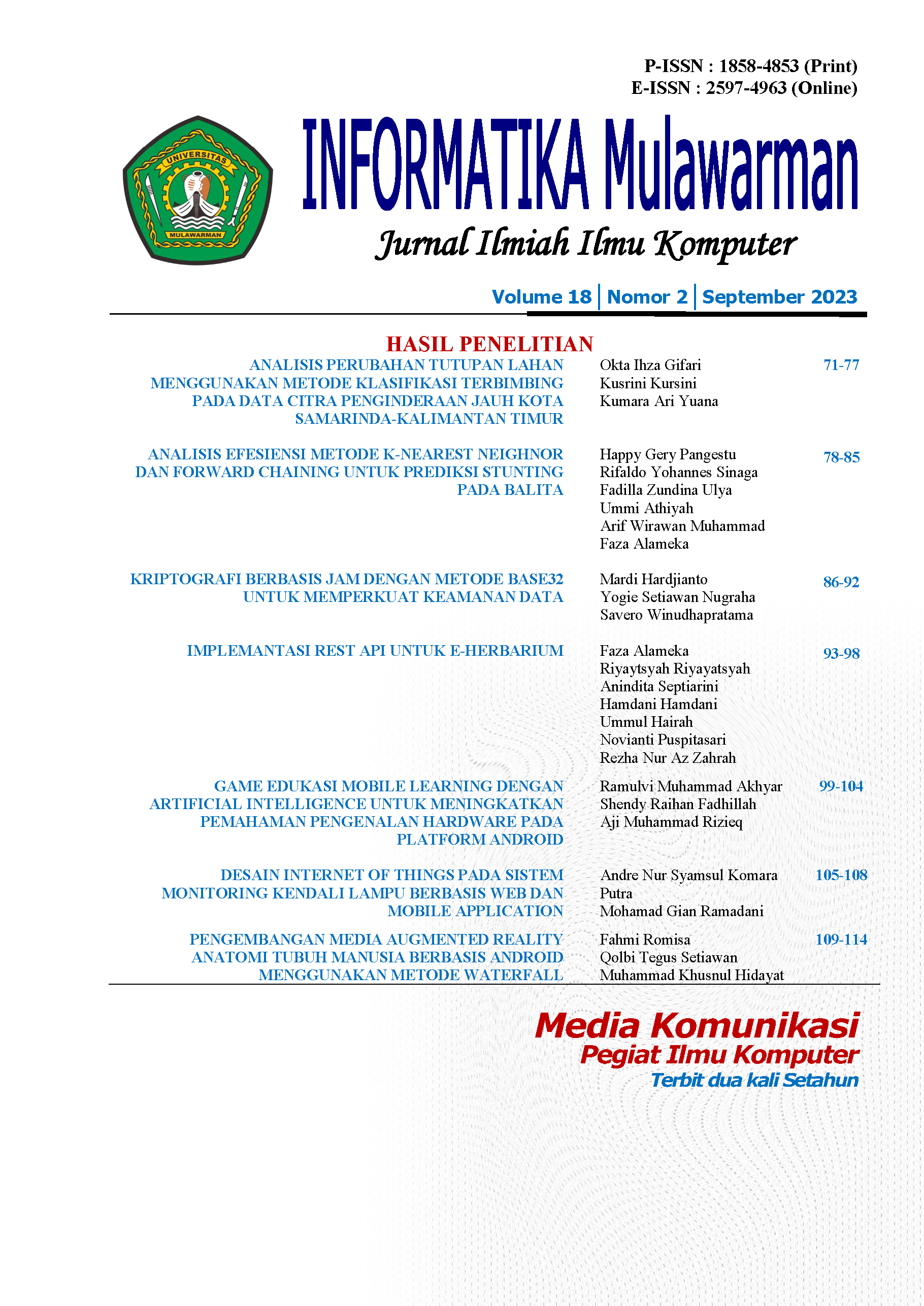
Game Edukasi Mobile Learning Dengan Artificial Intelligence Untuk Meningkatkan Pemahaman Pengenalan Hardware Pada Platform Android
DOI:
https://doi.org/10.30872/jim.v18i2.17712Keywords:
Mobile Learning, Android, Articial Intellegence, Education Game,Abstract
Dalam era Revolusi Industri 4.0, sistem pendidikan tetap fokus pada pengembangan kreativitas, berpikir kritis, kerjasama, komunikasi, serta karakter siswa. Kemampuan di bidang teknologi, media, informasi, pembelajaran, inovasi, dan karir sangat diutamakan. Teknologi, terutama game edukasi berbasis mobile learning dengan dukungan artificial intelligence (AI), memiliki peran penting dalam proses pembelajaran. Game edukasi ini dirancang untuk secara interaktif memperkenalkan perangkat keras kepada siswa. Dalam pengembangan game ini, AI digunakan untuk mengklasifikasikan gambar perangkat keras seperti Processor, GPU, Motherboard, RAM, HDD, SSD SATA, dan SSD M.2. Meskipun berhasil dalam pengujian, terdapat kesalahan dalam klasifikasi karena beberapa faktor seperti kualitas gambar yang buruk, kebisingan dalam gambar, dan perbedaan ukuran foto. Oleh karena itu, saran untuk pengembangan berikutnya adalah melakukan pre-processing pada gambar yang diambil untuk meningkatkan akurasi AI. Dengan demikian, game edukasi mobile learning berbasis AI diharapkan dapat meningkatkan minat dan motivasi belajar siswa, sambil membantu guru dalam menyediakan pengalaman pembelajaran yang lebih menyenangkan dan interaktif. Hal ini sejalan dengan pendekatan modern dalam pendidikan yang mendukung perkembangan keterampilan esensial yang diperlukan di era Industri 4.0.
References
Aditya Fajar Ramadhan, Ade Dwi Putra, & Ade Surahman. (2021). Aplikasi Pengenalan Perangkat Keras Komputer Berbasis Android Menggunakanaugmented Reality (Ar). Jurnal Teknologi Dan Sistem Informasi (JTSI), 2(2), 24–31. http://jim.teknokrat.ac.id/index.php/JTSI
Dinandra, F. (2020). Pengembangan Media Pembelajaran Game Edukasi Pokok Bahasan Pengenalan Perangkat Keras Komputer (Hardware) Berbasis Revolusi Industri 4.0. EduTeach : Jurnal Edukasi Dan Teknologi Pembelajaran, 1(1), 10–21. https://doi.org/10.37859/eduteach.v1i1.1807
Endra, R. Y., & Agustina, D. R. (2019). Media Pembelajaran Pengenalan Perangkat Keras Komputer Menggunakan Augmented Reality. EXPERT: Jurnal Manajemen Sistem Informasi Dan Teknologi, 9(2), 63–69. https://doi.org/10.36448/jmsit.v9i2.1311
Feng, Q. C., & Wang, X. (2022). Pengenalan Kecerdasan Buatan (Artificial Intelligence) Kepada Para Remaja. Procedia Computer Science, 166, 310–314. https://www.binadarma.ac.id
Hendriyana, H., Fuada, S., & Pradeka, D. (2022). Kenal Hardware: Media Pembelajaran Pengenalan Perangkat Keras Komputer Menggunakan Teknologi Augmented Reality Berbasis Android. Building of Informatics, Technology and Science (BITS), 4(1), 247–255. https://doi.org/10.47065/bits.v4i1.1648
Mair, Z. R. (2018). Teori dan Praktek Sistem Operasi . Yogyakarta: Deepublish.
Mulianingsih, F., Anwar, K., Shintasiwi, F. A., & Rahma, A. J. (2020). Artificial Intellegence Dengan Pembentukan Nilai Dan Karakter Di Bidang Pendidikan. IJTIMAIYA: Journal of Social Science Teaching, 4(2), 148. https://doi.org/10.21043/ji.v4i2.8625
Pressman, R. (2002). Software Engineering: A Practitioner Approach, New York: Mc Graw Hill.
Putriani, J. D., & Hudaidah, H. (2021).Penerapan Pendidikan Indonesia Di Era Revolusi Industri 4.0. Edukatif : Jurnal Ilmu Pendidikan, 3(3), 830–838. https://edukatif.org/index.php/edukatif/article/view/407
Safaat H, N. (2015). Rancang Bangun Aplikasi Multiplatform, Informatika.
Sarrab, M., Elgamel, L., & Aldabbas, H. (2012). Mobile Learning (M-Learning) and Educational Environments International Journal of Distributed and Parallel Systems (IJDPS). 3(4), 8.
Setiawan, A., Praherdhiono, H., & Suthoni, S. (2019). Penggunaan Game Edukasi Digital Sebagai Sarana Pembelajaran Anak Usia Dini. JINOTEP (Jurnal Inovasi Dan Teknologi Pembelajaran) Kajian Dan Riset Dalam Teknologi Pembelajaran, 6(1), 39–44. https://doi.org/10.17977/um031v6i12019p039
Sommerville, I. (2015). Software Engineering (10th Edition). Pearson.
Sugiyono. (2011). METODE PENELITIAN PENDIDIKAN (Pendekatan Kuantitatif, Kualitatif, dan R&D).
Sutopo, A. H. (2012). Teknologi Informasi dan Komunikasi dalam Pendidikan. Yogyakarta: Graha Ilmu.
Trisna, P., Permana, H., Luh, N., Ning, P., Astawa, S. P., & Kunci, K. (2020). Artificial Intelligence dalam Pengembangan Media Pembelajaran Bahasa Inggris. JIIP-Jurnal Ilmiah Ilmu Pendidikan, 3(3), 687–692. http://jiip.stkipyapisdompu.ac.id
Downloads
Published
Issue
Section
License
Copyright Transfer StatementThe copyright of this article is transferred to Informatika Mulawarman : Jurnal Ilmiah Ilmu Komputer and when the article is accepted for publication. the authors transfer all and all rights into and to paper including but not limited to all copyrights in the Informatika Mulawarman. The author represents and warrants that the original is the original and that he/she is the author of this paper unless the material is clearly identified as the original source, with notification of the permission of the copyright owner if necessary. The author states that he has the authority and authority to make and carry out this task.
The author states that:
- This paper has not been published in the same form elsewhere.
- This will not be submitted elsewhere for publication prior to acceptance/rejection by this Journal.
A Copyright permission is obtained for material published elsewhere and who require permission for this reproduction. Furthermore, I / We hereby transfer the unlimited publication rights of the above paper to Informatika Mulawarman : Jurnal Ilmiah Ilmu Komputer. Copyright transfer includes exclusive rights to reproduce and distribute articles, including reprints, translations, photographic reproductions, microforms, electronic forms (offline, online), or other similar reproductions.
The author's mark is appropriate for and accepts responsibility for releasing this material on behalf of any and all coauthor. This Agreement shall be signed by at least one author who has obtained the consent of the co-author (s) if applicable. After the submission of this agreement is signed by the author concerned, the amendment of the author or in the order of the author listed shall not be accepted.
Rights / Terms and Conditions Saved
- The author keeps all proprietary rights in every process, procedure, or article creation described in Work.
- The author may reproduce or permit others to reproduce the work or derivative works for the author's personal use or for the use of the company, provided that the source and the Informatika Mulawarman copyright notice are indicated, the copy is not used in any way implying the Journal of Informatika Mulawarman (JIM) approval of the product or service from any company, and the copy itself is not offered for sale.
- Although authors are permitted to reuse all or part of the Works in other works, this does not include granting third-party requests to reprint, republish, or other types of reuse.

Informatika Mulawarman by http://e-journals.unmul.ac.id/index.php/JIM/index is licensed under a Creative Commons Attribution-ShareAlike 4.0 International License.
under the CC BY-SA license, authors and other users are able to reprint, distribute or use the material for commercial purposes so long as they give attribution to the journal Informatika Mulawarman and license the republished material under the same license.