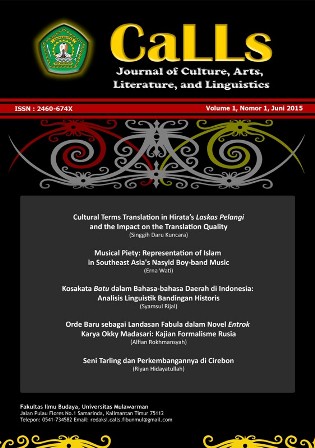
SENI TARLING DAN PERKEMBANGANNYA DI CIREBON
DOI:
https://doi.org/10.30872/calls.v1i1.709Abstract
The varieties of tarling music which keep changing and developing nowadays have brought two main concerns in our society: lack of identity function and music distortion. These issues may affect the loss of the originality of tarling music itself. This study aimed at knowing the development of tarling Cirebon and the change of tarling music at present day. The method used in this study was descriptive qualitative. The data regarding the art and tarling music were collected through library research and interview. Generally, tarling music is divided into two types: classical tarling music and modern Cirebon tarling music. Tarling music is the combination of different music genres like pop and dangdut. The collection of ideas of a certain community and that of the consolidated thoughts have become the sources of the tarling music development.
Keywords: classical tarling, modern tarling, Cirebon
References
Hove, Van. 1984. Ensiklopedi Indonesia. Jakarta: Ichtiar Baru.
Koentjaraningrat. 1990. Sejarah Teori Antropologi. Jakarta: UI-Press.
Kuntowijoyo. 2006. Budaya dan Masyarakat. Yogyakarta: Tiara Wacana.
Tjahjodiningrat, Harry. 2009. Abdul Adjib Tokoh Pengembangan Seni Tarling Dari Kota Cirebon. Sekolah Pascasarjana UPI Bandung.
Tim Teknis Pendataan Potensi Kebudayaan daerah dan Penyusunan Pola Pokok Pembinaan Kebudayaan Daerah Kabupaten DT II Cirebon, Himpunan Deskripsi Kesenian Daerah Cirebon, Pemda Kab. Cirebon, Cirebon 1992.
Website: Disbudpar Jawa Barat.
Downloads
Published
Issue
Section
License

Every works in CaLLs is licensed under a Creative Commons Attribution-ShareAlike 4.0 International License.
Authors who publish with this journal agree to the following terms:
- Authors retain copyright and grant the journal right of first publication with the work simultaneously licensed under a Creative Commons Attribution License that allows others to share the work with an acknowledgment of the work's authorship and initial publication in this journal.
- Authors are able to enter into separate, additional contractual arrangements for the non-exclusive distribution of the journal's published version of the work (e.g., post it to an institutional repository or publish it in a book), with an acknowledgment of its initial publication in this journal.
- Authors are permitted and encouraged to post their work online (e.g., in institutional repositories or on their website) prior to and during the submission process, as it can lead to productive exchanges, as well as earlier and greater citation of published work (See The Effect of Open Access).
