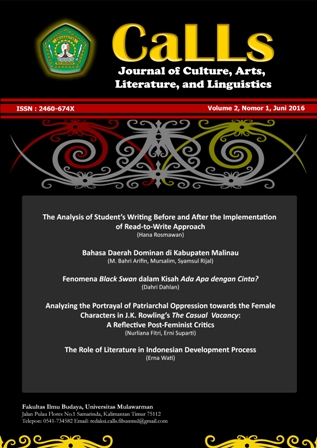
THE ROLE OF LITERATURE IN INDONESIAN DEVELOPMENT PROCESS
DOI:
https://doi.org/10.30872/calls.v2i1.704Abstract
In Indonesia, literature has been one of critical media to respond to the political and social issues. This study reviewed three literary works of the three Indonesian writers from different era: Bumi Manusia (1980) by Pramoedya Ananta Toer, Potret Pembangunan dalam Puisi (1980) by W.S. Rendra and Laskar Pelangi (2008) by Andrea Hirata. In this study, the writer analyzed how each literary work conceive the idea of political and educational development and how they contribute positive impacts to the development process of Indonesia society. The findings confirm each literary work has some similarities to the other in regards to contribute the idea of Indonesia development. The three authors agreed that education is an effective aspect to develop Indonesia society. They also have the same opinion that education which has a better quality is not always come from the formal institution. They depict a wider concept of education which is obtained from the fantastic culture and moral values.
Keywords: Indonesian literature, the role of literature, development
References
Hirata, A. 2008. Laskar Pelangi. Yogyakarta: Bentang.
Jabrohim. 1994. Pengajaran Sastra. Yogyakarta: Pustaka Pelajar.
Laurenson, D. & Swingewood, A. 1971. The Sociology of Literature. London: MacGibbon & Kee.
Moechtar. 2005. Multatuli: Pengarang Besar, Pembela Rakyat Kecil, Pencari Keadilan dan Kebenaran. Jakarta: Pustaka Jaya.
Rendra. 1980. Potret Pembangunan Dalam Puisi. Jakarta: Pustaka Jaya.
Toer, A. P. 1980. Bumi Manusia. Malaysia: Wira Karya.
Wellek, R. & Warren, A. 1973. Theory of Literature. England: Penguin Books.
Downloads
Published
Issue
Section
License

Every works in CaLLs is licensed under a Creative Commons Attribution-ShareAlike 4.0 International License.
Authors who publish with this journal agree to the following terms:
- Authors retain copyright and grant the journal right of first publication with the work simultaneously licensed under a Creative Commons Attribution License that allows others to share the work with an acknowledgment of the work's authorship and initial publication in this journal.
- Authors are able to enter into separate, additional contractual arrangements for the non-exclusive distribution of the journal's published version of the work (e.g., post it to an institutional repository or publish it in a book), with an acknowledgment of its initial publication in this journal.
- Authors are permitted and encouraged to post their work online (e.g., in institutional repositories or on their website) prior to and during the submission process, as it can lead to productive exchanges, as well as earlier and greater citation of published work (See The Effect of Open Access).
