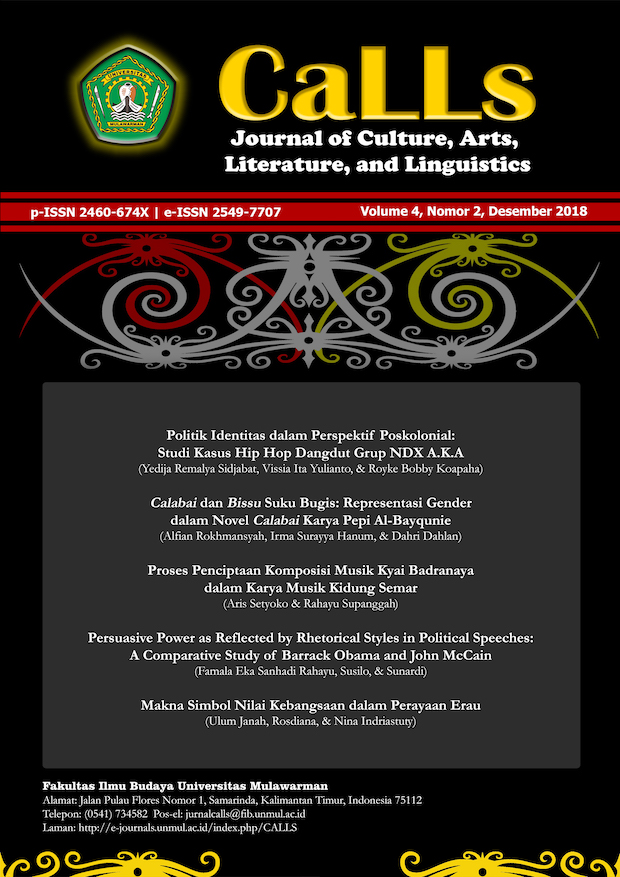
POLITIK IDENTITAS DALAM PERSPEKTIF POSKOLONIAL STUDI KASUS HIP HOP DANGDUT GRUP NDX A.K.A
DOI:
https://doi.org/10.30872/calls.v4i2.1693Keywords:
hip hop dangdut, political identity, postcolonialAbstract
Hip hop dangdut is music identity of NDX A.K.A group. Hip hop dangdut that became popular in society also bring the pros and cons for some groups. Political identity in this research investigates background in choosing music dangdut and hip hop that integrated in NDX’s songs. Political identity used to see the factor that played a role in formation of hip hop dangdut, but not fully realized by NDX group. Political identity in formation of hip hop dangdut then analyzed in textual and contextual to answer the contestation of hip hop dangdut in postcolonial perspective. The concept postcolonial in this research is criticized dominance or the form of leadership culture (hegemony) conducted by capitalists. Hip hop dangdut formed because of the hegemony of media in popularizing hip hop that occurs massively. Contestation on hip hop dangdut identity is analyzed using the concept of mimicry and hybridity to see ‘in-between’ space or third space that can be described the position of hip hop dangdut. Negotiations between hip hop and dangdut is a form of hybridity that takes place in ambivalence, which is mimicking and mocking, and not entirely subordinated to the cultural discrimination that occurs to the strategy of globalization. The performance and NDX music that performed on stage shows the cultural identity negotiations between hip hop and dangdut that formed in the third space.
References
Abe, D. 2009. “Hip-hop and the Academic Canon” dalam Education, Citizenship and Social Justice, 4(3), 263-272. DOI:10.1177/1746197909340872
Ashcroft, B., Griffiths, G., & Tiffin, H. 2006. The Post-Colonial Studies Reader. 2nd ed. London & New York: Routledge.
Bhabha, H. 1984. “Of Mimicry and Man: The Ambivalence of Colonial Discourse”. Spring, 28, 125-133. DOI:10.2307/778467
Bhabha, H. 1984. The Location of Culture. London: Routledge.
Birowo, Y. M. A. 2005. “Melawan Hegemoni Media dengan Strategi Komunikasi Berpusat pada Masyarakat” dalam Jurnal Ilmu Komunikasi, 2(2), 127-143. DOI:10.24002/jik.v2i2.246
Boothman, D. 2008. “The Sources for Gramsci's Concept of Hegemony” dalam Rethinking Marxism, 20(2), 201-215. DOI:10.1080/ 08935690801916942
Gramsci, A. 1999. Selections From The Prison Notebook. London: Elecbook.
Gunawan, I. 2013. Metode Penelitian Kualitatif. Jakarta: Bumi Aksara.
Hall, Stuart. 1994. “Cultural Identity and Diaspora” dalam Williams, P. & Chrisman, L. (Eds). Colonial Discourse and Post-Colonial Theory. London: Lawrence & Wishart. http://ls-tlss.ucl.ac.uk/course-materials/ELCS6088_74357.pdf
Hawley, J. C. 2001. Encyclopedia of Postcolonial Studies. London: Greenwood Press.
Kellner, D. 1995. Culture Studies, Identity and Politics between The Modern and The Postmodern. London: Routledge.
Khadavi, M. J. 2014. “Dekonstruksi Musik Pop Indonesia dalam Perspektif Industri Budaya” dalam Jurnal Humanity, 9(2), 47-56. http://ejournal.umm.ac.id/index.php/humanity/article/view/2392
Kroier, J. 2012. “Music, Global History, and Postcoloniality” dalam International Review of the Aesthetics and Sociology of Music, 43(1), 139-186. http://www.jstor.org/stable/41552766
Perkins, W. E. 1996. Droppin’ Science: Critical Essays on Rap Music and Hip Hop Culture. Philadelphia: Temple University Press.
Simatupang, Lono. 1996. “Dangdut is Very… Very… Very Indonesia: The Search for Cultural Nationalism in Indonesia Popular Music” dalam Bulletin Antropologi, 11(20), 55-74.
Sternberg, R. J. (Ed.). 1999. Handbook of Creativity. Cambridge, U.K. ; New York: Cambridge University Press.
Strinati, D. 2004. An Introduction Theories of Popular Culture. London: Routledge.
Vivian, Y. I. 2015. “Karakteristik Musikal pada Album Kompilasi Karya Komunitas Jazz Jogja” dalam CaLLs, 1(2), 20-31. DOI:10.30872/calls.v1i2.689
Downloads
Published
Issue
Section
License

Every works in CaLLs is licensed under a Creative Commons Attribution-ShareAlike 4.0 International License.
Authors who publish with this journal agree to the following terms:
- Authors retain copyright and grant the journal right of first publication with the work simultaneously licensed under a Creative Commons Attribution License that allows others to share the work with an acknowledgment of the work's authorship and initial publication in this journal.
- Authors are able to enter into separate, additional contractual arrangements for the non-exclusive distribution of the journal's published version of the work (e.g., post it to an institutional repository or publish it in a book), with an acknowledgment of its initial publication in this journal.
- Authors are permitted and encouraged to post their work online (e.g., in institutional repositories or on their website) prior to and during the submission process, as it can lead to productive exchanges, as well as earlier and greater citation of published work (See The Effect of Open Access).
