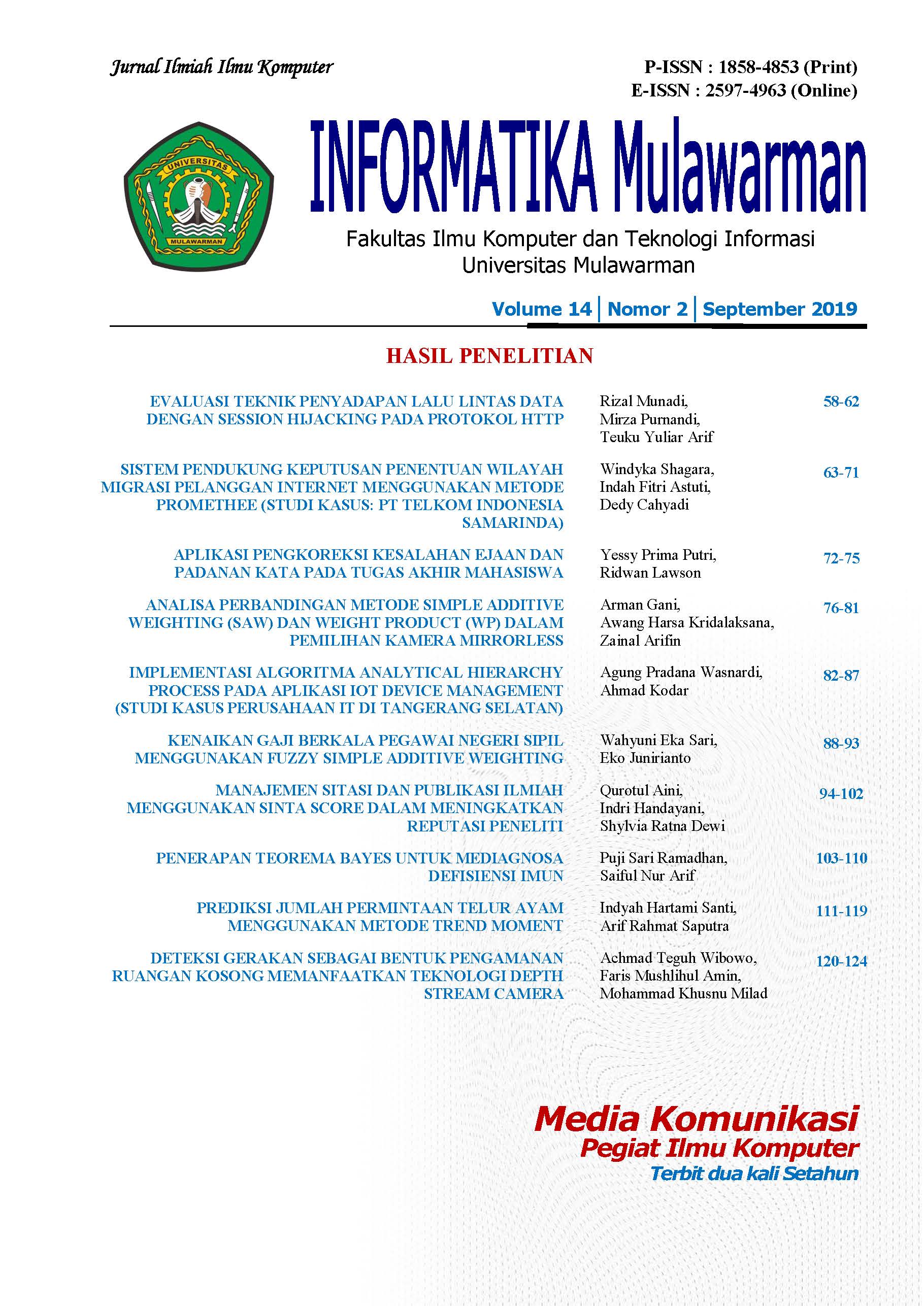
Implementasi Algoritma Analytical Hierarchy Process Pada Aplikasi IoT Device Management (Studi Kasus Perusahaan IT Di Tangerang Selatan)
DOI:
https://doi.org/10.30872/jim.v14i2.1791Keywords:
Analytical Hierarchy Process, Sistem Penunjang Keputusan, IoT Device ManagementAbstract
Menerapkan Internet of Things pada perangkat elektronik bukanlah cara yang mudah jika tidak dikelola dengan baik, terutama di sebuah ruang lingkup perusahaan. Itu karena beberapa perusahaan menaruh perhatian pada tanggung jawab mereka jika perangkat diterapkan. Perusahaan itu sendiri perlu mengelola perangkat Internet of Things yang mempengaruhi pengeluaran perusahaan dan membuat sebuah penggunaan energi yang lebih baik, efisien, dan bijaksana..Sebuah sistem yang dapat menunjukkan kepada pengguna jumlah energi yang mereka keluarkan pada setiap waktu dan juga memungkinkan mereka menetapkan batas penggunaan daya mereka dengan mengaktifkan dan menonaktifkan perangkat mereka dari jarak jauh akan menjadi solusi yang baik untuk energi masalah manajemen. Analytical Hierarchy Process (AHP), muncul sebagai salah satu metode yang sering digunakan dalam banyak hal untuk memecahkan masalah dengan menghasilkan suatu prioritas berdasarkan kriteria dan alternatif. Untuk menangani masalah yang ada, penulis akan membuat sebuah penelitian mengenai metode AHP yang diimplementasikan pada sebuah aplikasi manajemen Internet of Things untuk menentukan perangkat mana yang memiliki prioritas untuk dinyalakan. Sistem akan memberikan peringkat pada perangkat berdasarkan bobot akhir yang dihasilkan, sehingga pengguna lebih mudah dalam mengelola perangkat Internet of Things yang terintegrasi.References
Apriliani, E. P., & Ranggadara, I. (2018). ANALYSIS AND DESIGN OF KOREA MERCHANDISE SALES SYSTEM ( CASE STUDY IN SUEWEETIESID ). International Journal of Computer Science and Mobile Computing, 7(6), 197–209.
Azza, G. M., & Dores, A. (2018). SISTEM INFORMASI MANAJEMEN MARKETING TOOLS SERTA PENERAPAN METODE AHP ( ANALYTICAL HIERARCHY PROCESS ) PADA PROSES UJI KUALITAS BARANG ( STUDI KASUS : PT EDI INDONESIA ). Jurnal Cendikia, XVI.
Georgakopoulos, D., & Jayaraman, P. P. (2016). Internet of Things: from internet scale sensing to smart services. Computing, 98(10), 1041–1058. https://doi.org/10.1007/s00607-016-0510-0
Jeevani, D., & Balajee, M. (2017). Effective Device Management for Internet of Things. International Journal of Engineering and Information Systems, 1(8), 172–181.
Maruthur, N. M., Joy, S. M., Dolan, J. G., Shihab, H. M., & Singh, S. (2015). Use of the Analytic Hierarchy Process for Medication Decision-Making in Type 2 Diabetes. PLOS ONE, 1–11. https://doi.org/10.1371/journal.pone.0126625
Omole, O. S., Akpobasah, D., & Atayero, A. A. (2016). Development of a Smart , Low-cost and Internet of Things-enabled System for Energy Management. 3rd International Conference on African Development Issues (CU-ICADI 2016), (June). https://doi.org/10.13140/RG.2.1.3234.2643
Ravi Kiran Varma P, P L N Raju., M Priyanka (2017). An Internet of Things application for environmental monitoring and control using Raspberry-Pi. International Journal of Engineering and Technology, 9(3S), 546–552. https://doi.org/10.21817/ijet/2017/v9i3/170903S082
Priyono, M., Sulistyanto, T., Nugraha, D. A., Sari, N., Karima, N., & Asrori, W. (2015). Implementasi Internet of Things ( Internet of Things ) dalam pembelajaran di Universitas Kanjuruhan Malang. SMARTICS Journal, 1(1), 20–23.
Ranggadara, I., & Sahara, R. (2017). Analytical Hierarchy Process Algorithm Approach for Determining Best Employee ( Case Study IT Company in Jakarta ). International Journal of Computer Science and Mobile Computing, 6(12), 59–64.
Sheng, Z., Mahapatra, C., & Member, S. (2015). Recent Advances in Industrial Wireless Sensor Networks Towards Efficient Management in Internet of Things. IEEE. https://doi.org/10.1109/ACCESS.2015.2435000
Yu, J., Kim, M., Bang, H. C., Bae, S. H., & Kim, S. J. (2016). Internet of Things as a applications: cloud-based building management systems for the Internet of Things. Multimedia Tools and Applications, 75(22), 14583–14596. https://doi.org/10.1007/s11042-015-2785-0
Downloads
Additional Files
Published
Issue
Section
License
Copyright Transfer StatementThe copyright of this article is transferred to Informatika Mulawarman : Jurnal Ilmiah Ilmu Komputer and when the article is accepted for publication. the authors transfer all and all rights into and to paper including but not limited to all copyrights in the Informatika Mulawarman. The author represents and warrants that the original is the original and that he/she is the author of this paper unless the material is clearly identified as the original source, with notification of the permission of the copyright owner if necessary. The author states that he has the authority and authority to make and carry out this task.
The author states that:
- This paper has not been published in the same form elsewhere.
- This will not be submitted elsewhere for publication prior to acceptance/rejection by this Journal.
A Copyright permission is obtained for material published elsewhere and who require permission for this reproduction. Furthermore, I / We hereby transfer the unlimited publication rights of the above paper to Informatika Mulawarman : Jurnal Ilmiah Ilmu Komputer. Copyright transfer includes exclusive rights to reproduce and distribute articles, including reprints, translations, photographic reproductions, microforms, electronic forms (offline, online), or other similar reproductions.
The author's mark is appropriate for and accepts responsibility for releasing this material on behalf of any and all coauthor. This Agreement shall be signed by at least one author who has obtained the consent of the co-author (s) if applicable. After the submission of this agreement is signed by the author concerned, the amendment of the author or in the order of the author listed shall not be accepted.
Rights / Terms and Conditions Saved
- The author keeps all proprietary rights in every process, procedure, or article creation described in Work.
- The author may reproduce or permit others to reproduce the work or derivative works for the author's personal use or for the use of the company, provided that the source and the Informatika Mulawarman copyright notice are indicated, the copy is not used in any way implying the Journal of Informatika Mulawarman (JIM) approval of the product or service from any company, and the copy itself is not offered for sale.
- Although authors are permitted to reuse all or part of the Works in other works, this does not include granting third-party requests to reprint, republish, or other types of reuse.

Informatika Mulawarman by http://e-journals.unmul.ac.id/index.php/JIM/index is licensed under a Creative Commons Attribution-ShareAlike 4.0 International License.
under the CC BY-SA license, authors and other users are able to reprint, distribute or use the material for commercial purposes so long as they give attribution to the journal Informatika Mulawarman and license the republished material under the same license.